- Check the deployed package versions, not just the planned update.
- An updated verifier does not establish what happened to old cached records.
Sourcify published three security advisories on November 17: one critical server code-execution issue and two moderate flaws that could produce misleading contract-verification results. The demonstrations described local testing, not a confirmed breach of the hosted service.123
Versions to check
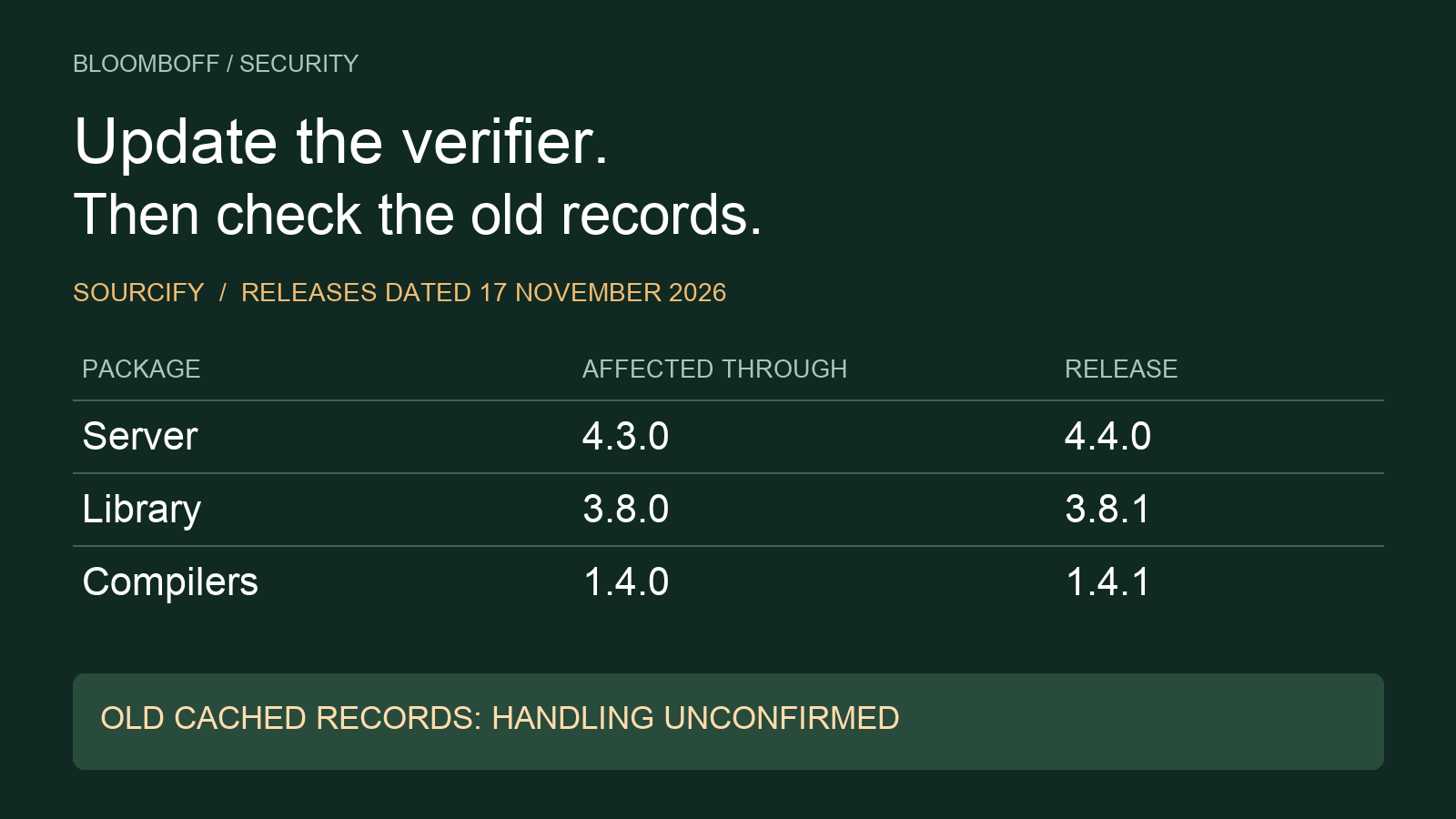
Server: the advisories identify sourcify-server 4.3.0 and earlier as affected. Release 4.4.0 lists deployed-code checks and input-validation hardening.1234
Library: lib-sourcify 3.8.0 and earlier are affected. Release 3.8.1 lists library call-protection, deployed-code and input-validation fixes.1234
Compilers: the critical advisory identifies compilers 1.4.0 and earlier. Release 1.4.1 lists input-validation hardening.14
These releases are dated November 17. The advisory fields still display “None” under patched versions; the separate release notes describe the corrections. We have not independently tested those fixes or established the hosted service’s deployed version.1234
What to check after updating
Our proposed operator checklist separates installing code from trusting stored results:
1. Record the server and library versions actually running, including the compilers package where applicable. Keep the deployment evidence, not just the intended version.
2. For a cached verification result, record its provider, observation time, chain, contract address and whether its claim concerns creation code, runtime code or both.
3. Establish whether earlier results were invalidated or recomputed. If that cannot be established, record it as unresolved rather than assuming the software update refreshed every stored result.
4. For a decision that depends on current deployed code, obtain current verification evidence and investigate discrepancies before relying on the old badge. A source-code match alone is not a security audit.
This is a proposed review method, not a vendor migration instruction. We have not established how historical cached records were handled. The issue remains open; no automatic invalidation or completed re-verification is claimed.
Bloomboff's take
A badge compresses a chain of assumptions into a reassuring word. The useful question is who checked what, against which current evidence. The same discipline supports Bitcoin ownership: verify the monetary rules with your own node and keep signing authority under your control, rather than treating a provider’s label as a guarantee. That independence is a skill to teach through node verification and safe self-custody practice. It does not repair a contract verifier or certify a wallet application.