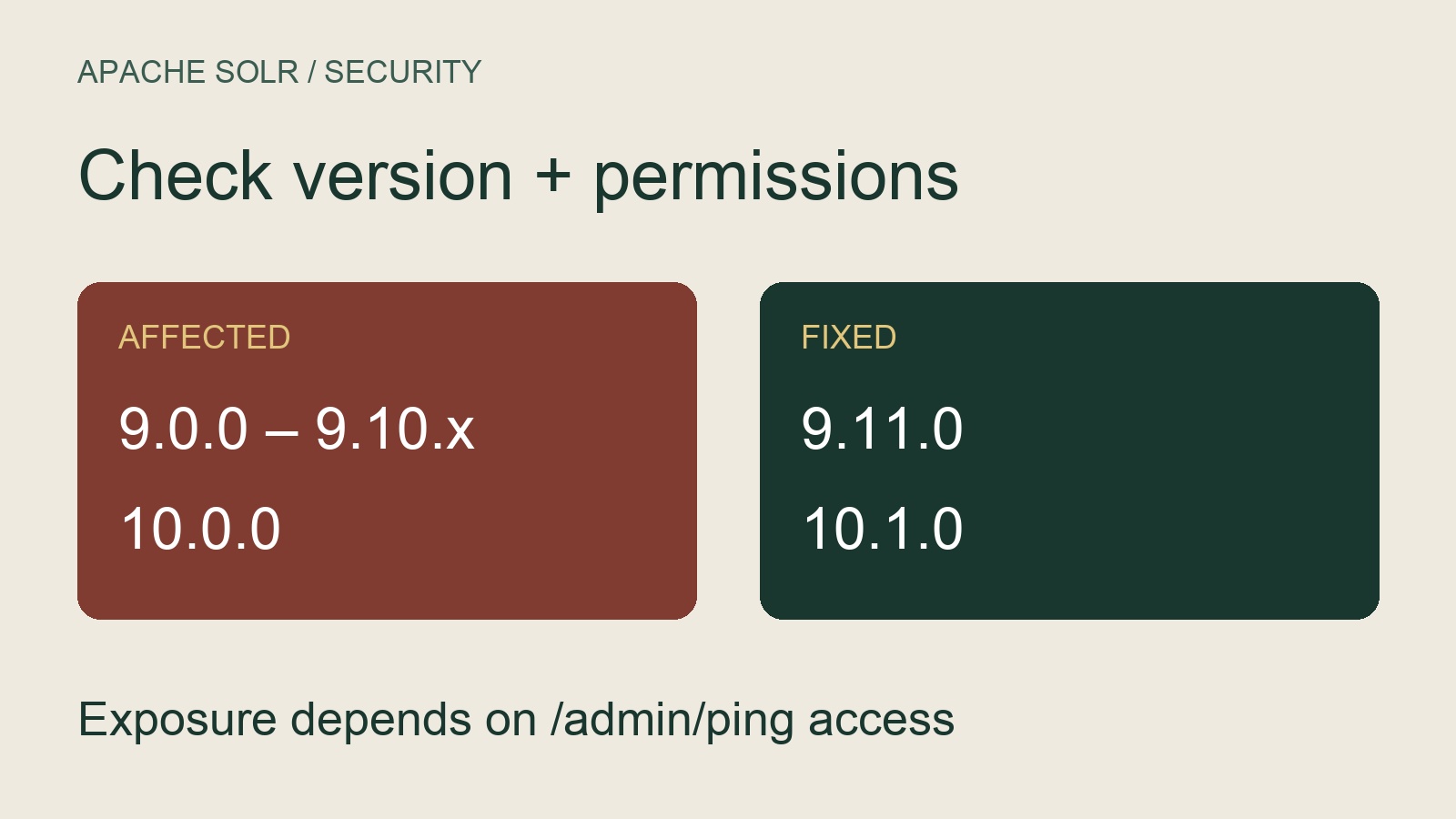
Apache's November 23 advisory warns that Solr's health-check endpoint can bypass authorization in affected configurations. CVE-2026-86312 affects 9.0.0 through 9.10.x and 10.0.0. Exposure requires access to /admin/ping with only the health permission; the CLI's sample configuration leaves it unauthenticated.1
Upgrade to 9.11.0 or 10.1.0 or newer. Apache's download page lists both release packages; the linked fix is merged. We have not tested those binaries.123
If upgrading must wait, Apache recommends restricting the endpoint to a trusted role and keeping Solr unreachable by untrusted clients. The advisory establishes a vulnerability, not a confirmed customer breach.1
Bloomboff's take: observation should not confer control
A health check answers whether a service is working. Giving that observer wider authority violates the boundary that made the permission useful. Operators should examine what their monitoring systems can actually do, rather than trusting the reassuring name of a permission.
That distinction also matters for monetary ownership. A Bitcoin business can expose transaction information to a watch-only service while retaining spending keys separately. The public-facing service then observes money without being entrusted to move it. The benefit comes from deliberately separating those powers, not from adding a Bitcoin logo to vulnerable software.
Bitcoin's stronger proposition is ownership that does not require a service provider to hold the owner's spending authority. Realising it requires education in watch-only versus signing wallets, recipient verification and protected recovery material. Schools can teach those distinctions with simulations. Software still needs its security fix; the savings need not share every dependency of the website.