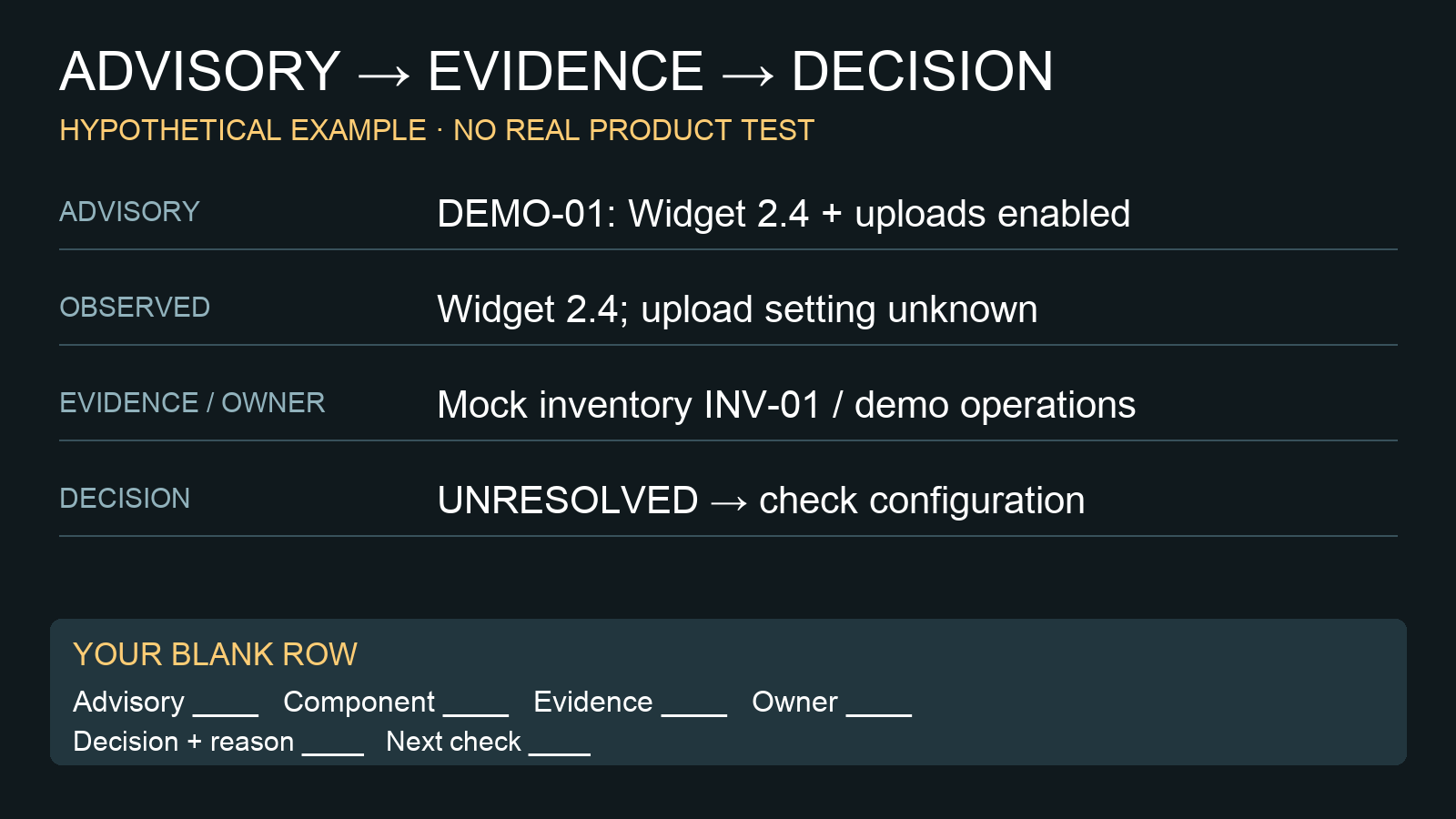
Hypothetical example: DEMO-01 concerns the invented Widget component, version 2.4, only when uploads are enabled. Demo-host has version 2.4, but its upload setting is undocumented. Decision: unresolved. Owner: demo operations. Next action: verify that setting, then reassess. Nothing here reports a real vulnerability or a product test.
Blank reader row: advisory and original URL | host/component | observed version/build | required and observed configuration | evidence and timestamp | responsible owner | decision, reason and next check.
A version match starts an investigation; it does not finish one. Cisco's own VEX documentation distinguishes affected, not affected, fixed and under-investigation states. Its assessments consider how a particular product uses a component, and can change as information improves.1
Use this original worksheet for one advisory, one component and one host at a time. It is a working note, not a formal VEX document or a substitute for the vendor's assessment.
Filled example, entirely hypothetical
Advisory: DEMO-01, invented for this exercise; no real CVE or source URL. Stated condition: Widget 2.4 with uploads enabled.
Host/component: demo-host / Widget. Observed version: 2.4, build demo-A. These observations are stipulated fictional inputs, not measurements.
Configuration: the advisory requires uploads enabled; the mock record contains no upload-setting evidence. Missing evidence is not evidence that the feature is disabled.
Evidence: imaginary inventory record INV-01, exercise time 10:00 UTC; configuration record absent. Owner: demo operations. Decision: unresolved, because a required condition has not been checked. Next action: inspect the relevant configuration and document its evidence and time before revising the decision.
How to use your row
First, identify the actual component and running build, including any vendor patch or backport information. Then compare the advisory's conditions with observed configuration. Link each conclusion to evidence, an observation time and an accountable owner. Keep missing information explicitly unresolved.
Record applicability separately from evidence of exploitation, remediation priority and verification that a fix worked. Revisit the row when the advisory, build or relevant configuration changes. This worksheet grants no permission to ignore urgent vendor instructions.
Bloomboff's take
Independent ownership needs independent verification. A dashboard total delegates judgement to someone else's classification; a traceable decision lets its owner explain what is known and what remains open. The same discipline makes Bitcoin's promise practical: learning to verify monetary rules and safely control keys is more valuable than trusting a balance display. Bitcoin does not patch vulnerable software. Its contribution is a model of ownership supported by verification, which education should make usable through simulations, recovery planning and careful handling of keys, never disclosure of real secrets in a worksheet.