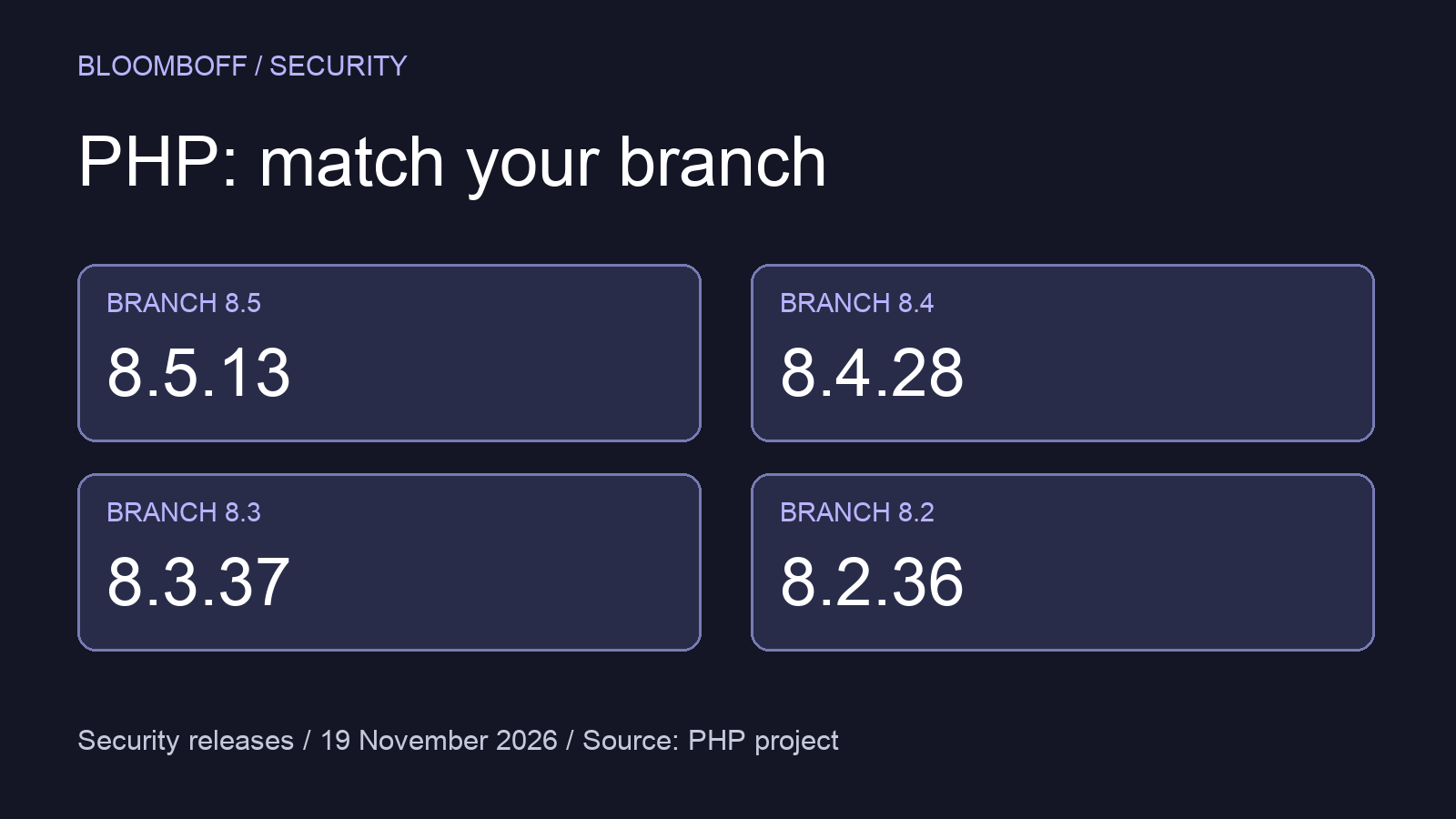
PHP has released security updates for four existing branches on November 19: 8.5.13, 8.4.28, 8.3.37 and 8.2.36. The project encourages users of each branch to upgrade.1
Its advance notice rated the most serious issues critical, while specifying that those issues require non-default configuration or uncommon setups. That qualification matters: the announcement does not mean every installation has the same exposure.1
Separately, PHP 8.6.0 is now available as a major language update. Applying a security update to an existing branch and migrating to a new major release are different decisions.1
Bloomboff’s take: keep a website failure away from the money
Start with an inventory of the PHP runtime actually serving the application. Match it to the corresponding release above, then check the hosting or operating-system vendor’s package notice. A provider may backport fixes without adopting the upstream version number. Confirm the package evidence rather than assuming that a matching dashboard label proves the running service changed.
Before deployment, preserve a usable recovery point and test the application’s important paths. This is an operator checklist, not a claim that Bloomboff tested these releases or that a patch guarantees an uncompromised system. The inspected announcement does not establish an active attack.
For a Bitcoin business, the important architectural question is what a compromised web process could authorize. A storefront can display an invoice without possessing the keys that spend a customer’s or merchant’s reserves. Keeping signing authority outside that process limits the power delegated to the public-facing service.
Bitcoin makes that separation possible at the ownership level: independently verified monetary rules and direct control need not depend on a website operator’s balance sheet or permission. The benefit comes from exercising that control deliberately, not merely putting a Bitcoin logo on a custodial application. Bitcoin does not patch PHP.
Education should teach the distinction between viewing a balance and holding spending authority. Practise recipient verification, separate operational access from recovery material, and rehearse recovery with test funds. Those are concrete steps towards monetary independence, alongside the ordinary engineering work of keeping software maintained.