PhoneBox lists v0.9.21 as released November 18. Its notes require custom-config users to pair again and sign in to Discord again, and describe control-boundary fixes.1 A separate November 18 owner comment reports a pending signing certificate; that does not establish the latest binary's signature.2
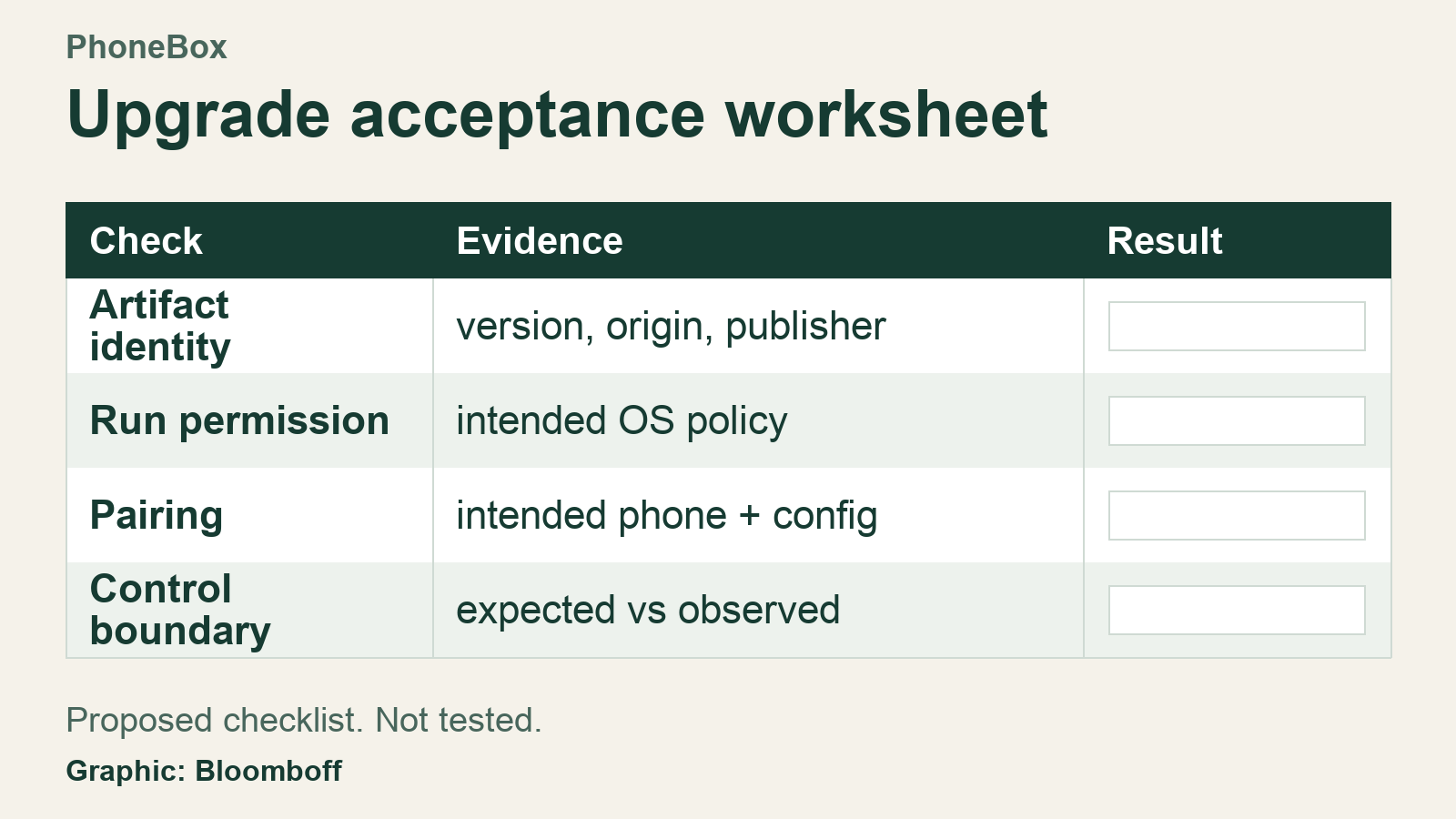
Before changing a working setup, define what a successful upgrade would demonstrate. This proposed acceptance worksheet gives each check a place for the intended result, the evidence collected and an honest outcome. It is designed to leave unresolved questions visible.
The worksheet below is Bloomboff's original proposed method. We have not installed or tested this release, inspected a downloaded binary or verified its signature. Every result starts empty.
Set the conditions first
Choose an authorized test setup and a harmless dummy action. Write down the release you intend to evaluate, the device, the configuration you intend to use and the operating-system protections you intend to keep. Preserve a recoverable configuration without putting secrets in screenshots or a public report.
Complete each row with your own observations. If the evidence is missing, leave the decision unresolved.
1. Artifact identity
Intended result: the file under review is the exact artifact you selected.
Evidence to collect: the release link, filename, platform, download time and any identity evidence you actually verified. Record the verification method beside the result.
Observed result: __________
Decision: __________
2. Permission to run
Intended result: the artifact runs under the operating-system policy you intend to retain.
Evidence to collect: the actual publisher or signature information you inspected, the policy in force and the observed launch outcome. Keep file identity, signature and run permission in separate fields. Do not enter a verdict about harmlessness in any of them.
Observed result: __________
Decision: __________
3. Pairing and configuration
Intended result: the intended device is connected to the intended configuration.
Evidence to collect: the device and configuration identity, the account authorization you actually completed and a harmless action you observed in that setup. Treat any uncompleted authorization as an open item.
Observed result: __________
Decision: __________
4. Control boundary
Intended result: a deliberately unavailable or removed dummy action remains unavailable in your authorized test setup.
Evidence to collect: the permission you intended to change, the before-and-after state and the outcome of one harmless check. Record an unexpected outcome without turning it into a broader vulnerability claim.
Observed result: __________
Decision: __________
5. Accepted outcome
Intended result: the evidence meets the pass conditions you wrote before starting.
Evidence to collect: what changed, what you observed, what remains unresolved and when you checked it. Include failures and incomplete checks in the same record.
Observed result: __________
Decision: __________
Keep the conclusion as narrow as the evidence
A useful completion note names the artifact, the configuration, the checks performed and the unresolved items. This blank worksheet offers a way to collect that record. It reports no product test result, compatibility finding or security endorsement.
Bloomboff's take: ownership needs an acceptance test
Convenience delegates work; it should not quietly delegate the owner's final authority. Whoever bears the cost of a failed upgrade needs a way to accept or reject it on evidence. The same principle applies to money: an attractive interface is not proof that its operator controls the underlying asset.
Bitcoin makes that distinction concrete. An owner can verify the monetary rules and retain spending keys independently of a service provider. That is a stronger foundation for saving than relying entirely on an issuer's promise not to dilute the unit. It also gives software a clear boundary: a tool may assist with information without receiving authority to spend.
For a Bitcoin user evaluating any control utility, keep signing and recovery material outside the test setup. This is our proposed separation of responsibilities, not a PhoneBox wallet feature or a security verdict. Schools can teach the principle with dummy transactions: state the intended recipient and amount, verify what is being authorized, and practise recovery without exposing real keys. Sovereignty becomes useful when the owner can demonstrate control, not merely assume it.