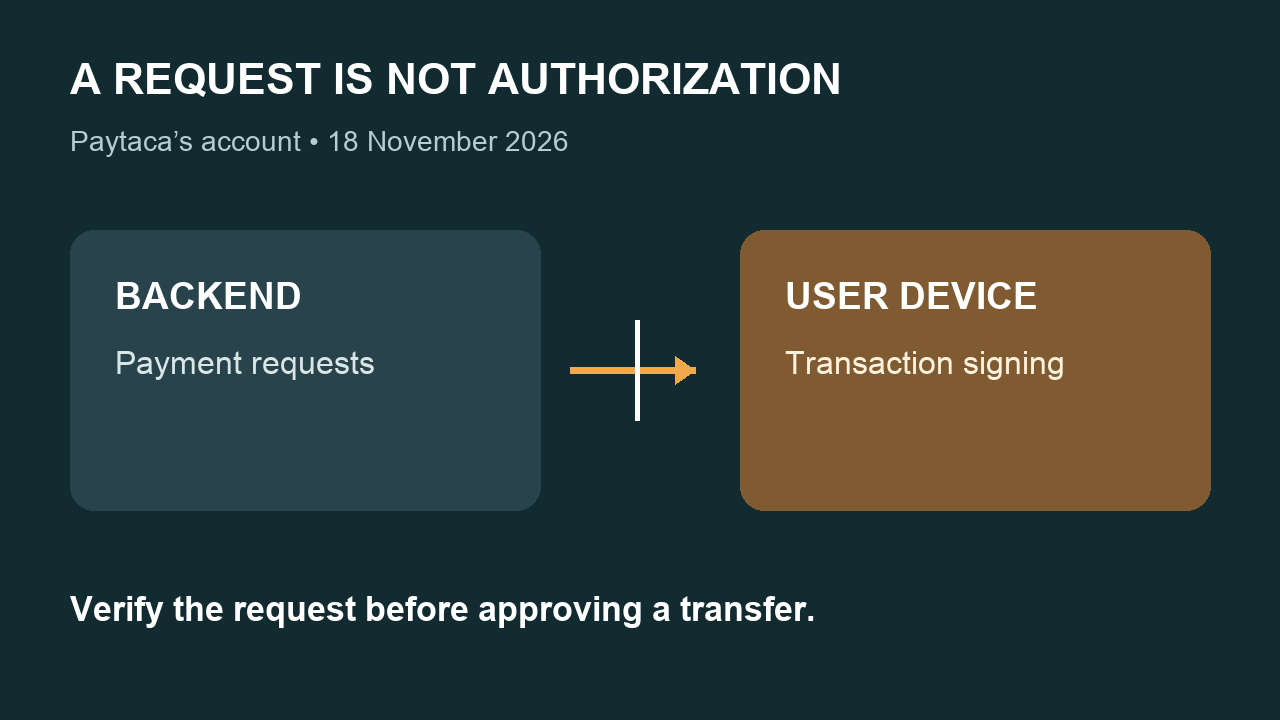
Paytaca says attackers exploited its P2P Ramp backend on November 17 to create fraudulent orders, then another backend vulnerability on November 18 to issue unsolicited payment requests. Its investigation and fixes were continuing when it posted the advisory.1
The company says private keys remain on users’ devices and were not targeted. That is the provider’s assurance, not an independent security audit. Its statement gives no verified loss total.1
Users should ignore unexpected requests, refuse unfamiliar transactions and keep recovery phrases private, Paytaca advises.1 Paytaca is a Bitcoin Cash wallet, distinct from Bitcoin.2
Bloomboff's take: owning the key must include owning the decision
Self-custody separates two powers that ordinary financial services often combine: presenting an instruction and authorizing the movement of money. An application can tell its user that a payment is due. That does not make the demand legitimate. The signature is where the owner’s decision becomes enforceable.
This distinction is central to Bitcoin’s promise of independent monetary ownership. A company can provide an interface without becoming the custodian of the money behind it. Public monetary rules and independently held keys let people choose services without surrendering the asset itself to the service provider’s balance sheet or discretion.
But control means examining the instruction before exercising that power. A deceptive request can recruit the owner into signing something the owner never intended. The answer is not to dismiss self-custody. It is to make verification part of ownership: understand the recipient, amount and purpose before approval, and confirm an unexpected demand through a separate trusted channel.
Monetary education should teach this practical separation alongside scarcity and saving. In schools, simulations can demonstrate the difference between receiving a request and signing a transfer without exposing real savings or recovery phrases. Bitcoin’s constructive contribution is the ability to retain that final decision. Good interfaces and informed users must make it meaningful.