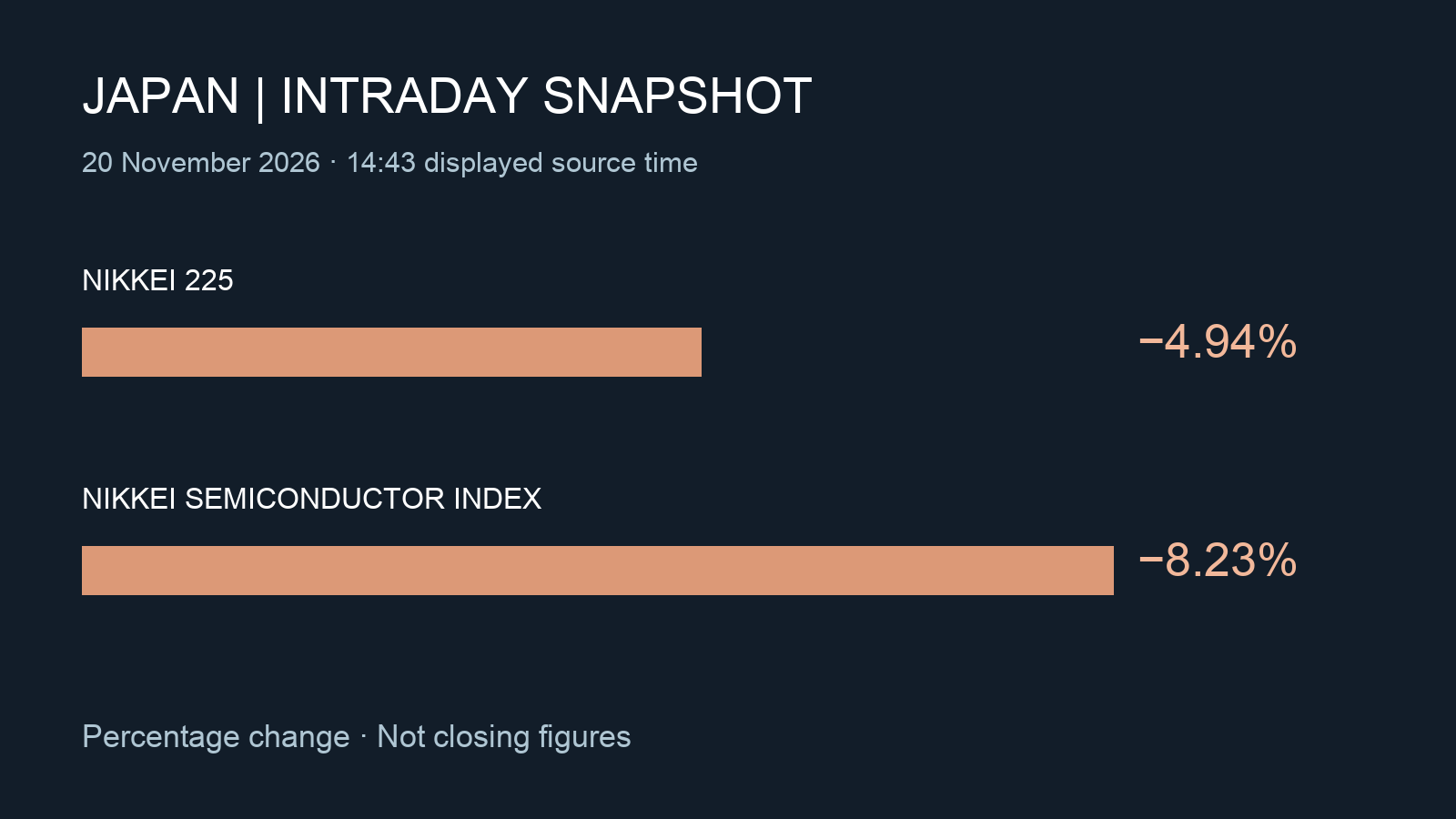
- Nikkei 225: 56,510.00 in the 14:43 snapshot.
- Semiconductor index: down 8.23% at the same displayed time.
Japan’s Nikkei 225 was down 4.94% at 56,510.00 in the index provider’s November 20 snapshot marked 14:43. The decline was 2,934.21 points.1
The provider’s semiconductor index was down 8.23% at the same displayed time. Its broader JPX-Nikkei 400 measure fell 3.70%.1
These are intraday observations, not closing results. The semiconductor measure’s larger percentage decline shows a sharper move within that basket; it does not establish what caused the market-wide fall. The snapshot alone cannot settle whether selling has reached a bottom.
Bloomboff’s take: a savings plan is not a growth forecast
A share price capitalizes expectations about future earnings. When those expectations change, yesterday’s valuation provides no floor. That is why productive investment and monetary saving deserve separate decisions, rather than treating a fashionable equity sector as a compulsory escape from currency debasement.
Bitcoin offers a different monetary proposition: issuance governed by rules that users can verify, without a company’s earnings target or a central bank’s discretion to create more units. Self-custody can also remove dependence on a broker’s permission to access those savings. Its case rests on monetary ownership, not on the claim that it rises whenever stocks fall.
A fixed supply does not fix the market price. People still need liquidity for near-term bills and a clear distinction between saving, speculation and borrowing. Monetary education should teach that distinction alongside safe self-custody: protected recovery material, recipient verification and practice before moving meaningful funds. The point is an informed choice of money, not a promise of immunity from a selloff.