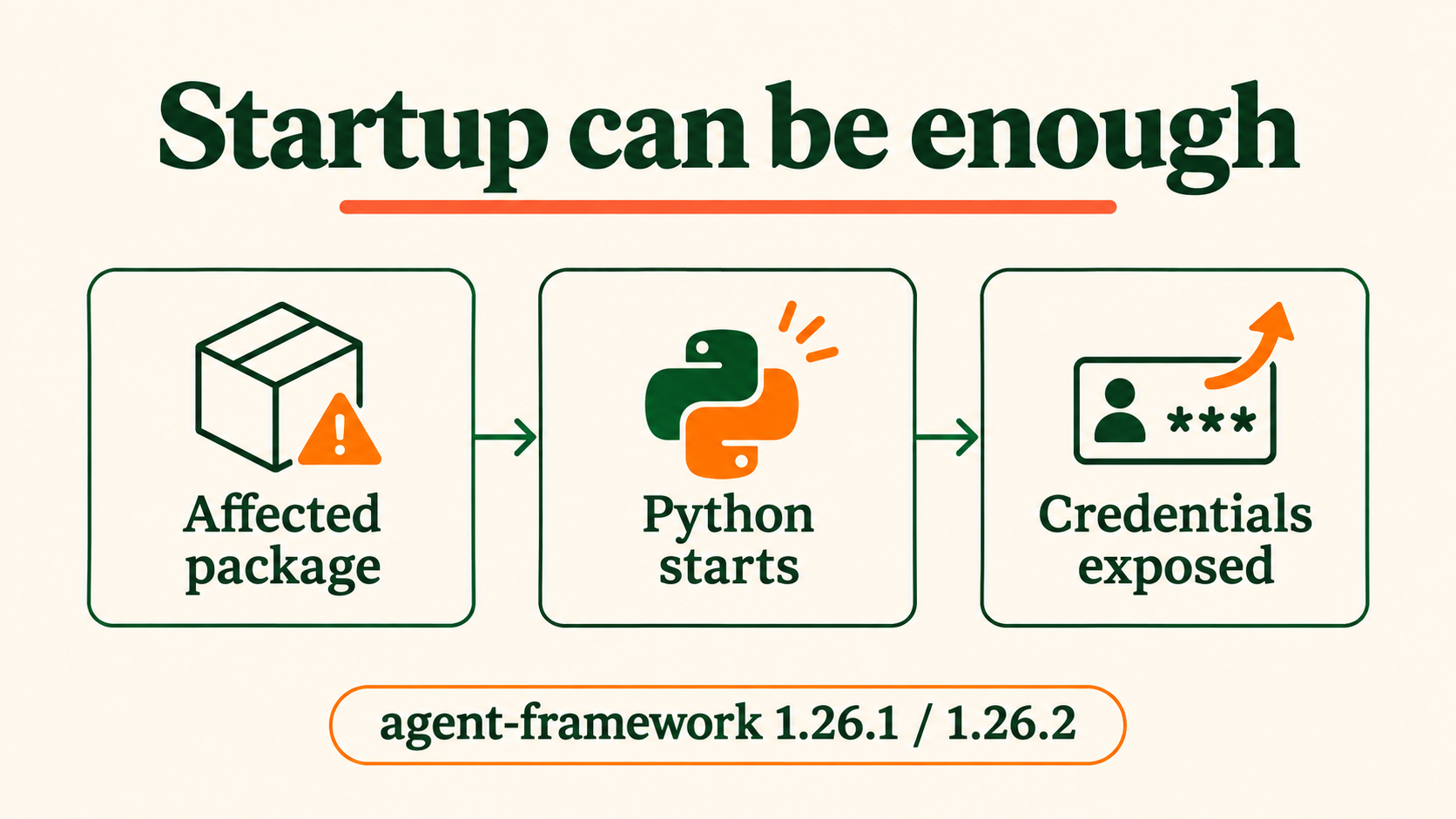
Socket reports that malicious agent-framework releases 1.26.1 and 1.26.2, published to PyPI on November 17, installed credential-stealing hooks that run when Python starts. Using the framework in application code was not required to trigger the startup mechanism.1
The researcher describes collection of environment secrets, local credential files and cloud identity tokens. This report concerns the named Python package releases, not every Microsoft service or every AI agent.1
BleepingComputer reported November 18 that both releases were quarantined, but how the attacker obtained publishing access remained unclear. Its remediation guidance: isolate affected environments, avoid running Python or pip there until secured, rebuild from a known-clean environment and rotate potentially exposed credentials.2
Quarantine does not undo an earlier installation. Inspect retained installation records and involve your security team if either version reached a development machine or build runner. The reports do not establish a victim count or a monetary-loss total. Bloomboff has not run the malicious packages.
Bloomboff's take
The important boundary here is not whether a developer deliberately called an AI function. It is what authority the surrounding environment makes available to software that starts automatically. An ordinary development tool can sit beside credentials that represent extraordinary power.
Bitcoin offers a particularly clear ownership principle: keep the authority to spend separate from the machinery used for unrelated work. Proper self-custody can remove a financial intermediary from that decision, but putting recovery secrets into a general-purpose development environment hands the power back to whatever code runs there. Independence requires a deliberate boundary, not merely a different account label.
A stronger system gives tools only the access their work needs and keeps real signing material outside routine automation. That is compatible with Bitcoin's wider promise of verifiable rules and voluntary exchange: the person remains the author of a payment, rather than silently delegating that choice to a dependency.
Monetary education should teach this distinction through safe simulations: inspect what a request authorizes, practise recovery without real secrets and verify the recipient before signing. Bitcoin does not repair a compromised Python installation. It provides a way to retain monetary authority outside it when custody is designed accordingly.