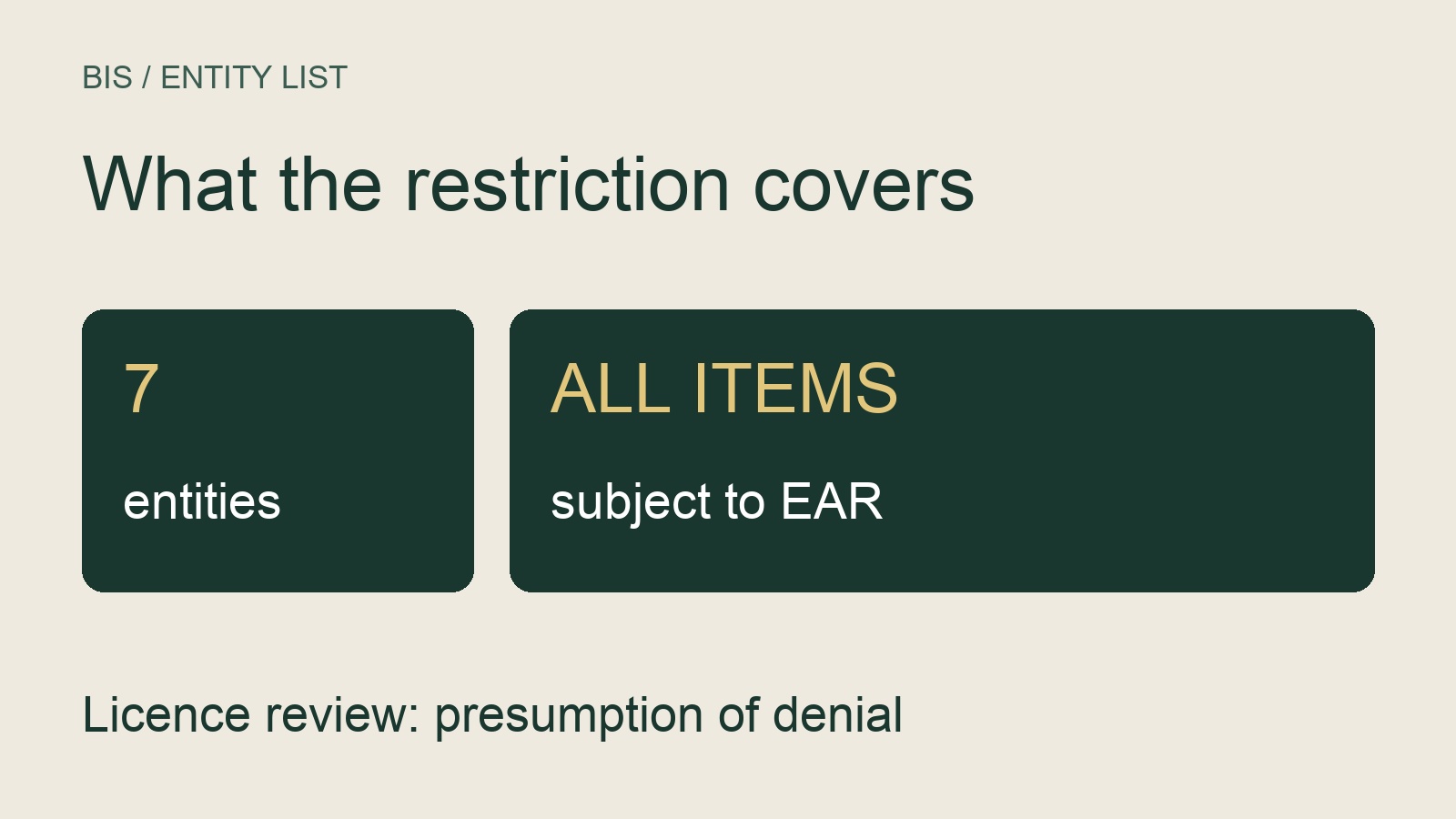
A U.S. Commerce Department final-rule document adds seven entities, including Singapore's Megaspeed International, to the Entity List. BIS cites a significant risk of advanced-computing products reaching unauthorized users or uses. That is the agency's determination, not a criminal conviction.1
The document requires licences for all items subject to the Export Administration Regulations, with applications reviewed under a presumption of denial. This is broader than a restriction on one chip model.1
The filing footer records November 23; Federal Register publication is scheduled for November 25. The effective-date field still contains an instruction to insert the public-inspection date. Do not confuse the scheduled publication date with a verified effective-date entry.1
Bloomboff's take: distinguish ownership from permission
A business can own equipment and still depend on permission to receive its next shipment. That dependency belongs in an investment decision alongside revenue and margins. Capital already committed to facilities cannot instantly become a substitute supply chain when access changes.
The monetary lesson is to examine which promises depend on an issuer or gatekeeper. Bitcoin gives an individual a different form of ownership: a monetary asset whose issuance rules can be independently checked, with direct control through self-custody. That can reduce dependence on discretionary monetary issuance and custodial account access. It does not confer a right to receive controlled equipment or remove exporters' obligations.
Our case for Bitcoin is a case for making peaceful saving and exchange less dependent on institutional discretion. Competent ownership requires education: distinguish keys from an account balance, protect recovery material and verify recipients. Schools can teach those principles with simulations. Monetary independence and responsibility belong together.