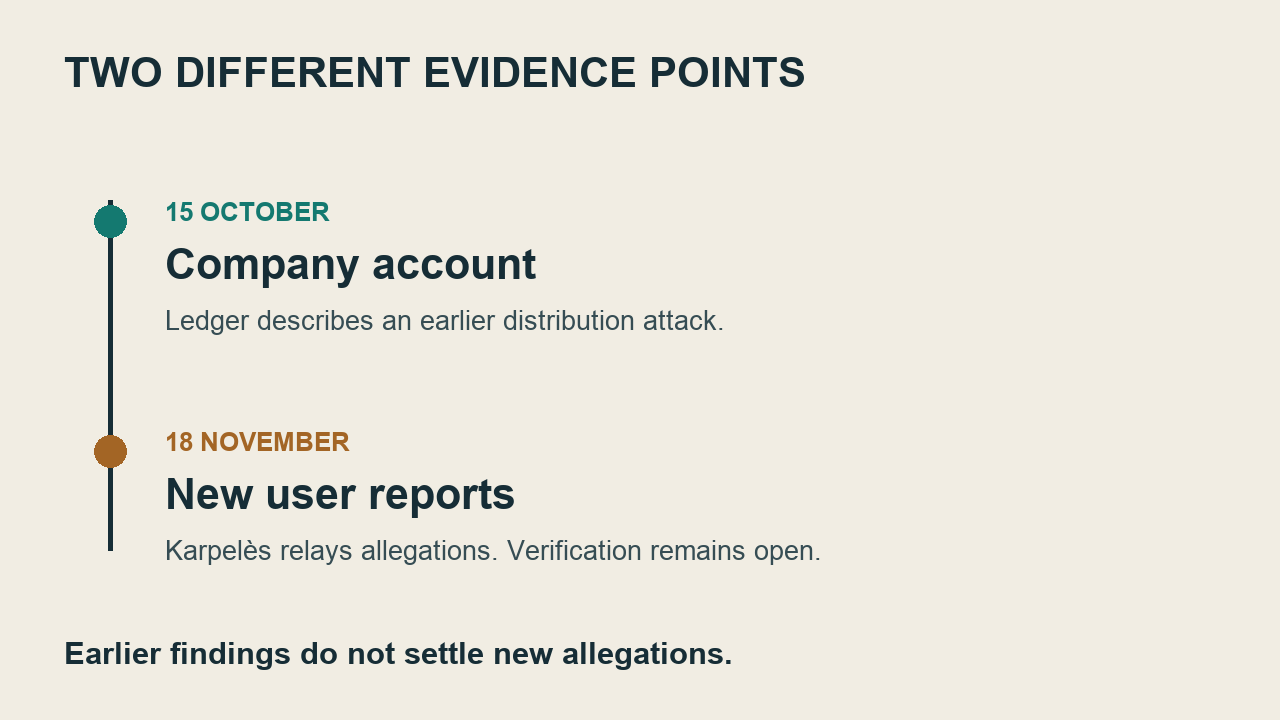
Mark Karpelès warned on November 18 that he was receiving reports of implanted Ledger devices bought from Virgin Megastores in the UAE. He explicitly described them as user reports. A subsequent post pointed to another allegation involving a purchase in Germany.12
Bloomboff has not independently verified those purchases, physical modifications or the cause of any reported losses. The posts do not establish that every device from either market is affected. Karpelès also warned people responding to the reports to avoid sponsored links and common scams.1
What Ledger previously confirmed
In its October 15 response to an earlier incident, Ledger said criminals had modified genuine devices to capture recovery phrases during setup and returned them to reseller distribution in Southeast Asia. It said its chip, operating system and servers were not compromised.3
The company said samples it examined from stores, including in Germany, and warehouses were clean. It instructed authorized sellers never to resell returned devices and to keep stock off displays. Those statements describe its earlier investigation; they neither verify nor resolve the new user reports.3
What remains unproven
This article establishes that the warnings were issued, not that the new allegations have been technically confirmed. It does not endorse opening a device or moving funds in haste. Never enter a recovery phrase into a website or give it to someone offering help. A frightening headline can itself become a lure for an impersonator.
Bloomboff’s take: independent money needs independent verification
Bitcoin separates monetary ownership from an institution’s promise to repay. That freedom is the point of holding keys yourself. But a commercial device is a tool for exercising ownership, not a substitute for understanding how that ownership works. A recognizable brand and an apparently intact box cannot carry the entire burden of trust.
The monetary and security questions belong together. Bitcoin’s public issuance rules constrain discretionary dilution; self-custody constrains another party’s power over a balance. Neither benefit requires treating the company that sells an interface as infallible. Competition should reward devices, distribution practices and recovery procedures that users can scrutinize.
The constructive response is competent ownership, not reflexive surrender to a custodian or panic-driven migration. Education should explain what a recovery phrase controls, how a recipient is verified and why an unsolicited support message has no authority over a wallet. Schools can teach these distinctions using simulations without real savings or real secrets.
For experienced users, understanding how to separate signing authority across independently controlled keys can be part of that education. Complexity is not automatically protection: a recovery plan must be understood and tested before it is entrusted with savings. Bitcoin’s promise is strongest when freedom is supported by practical knowledge rather than faith in packaging.