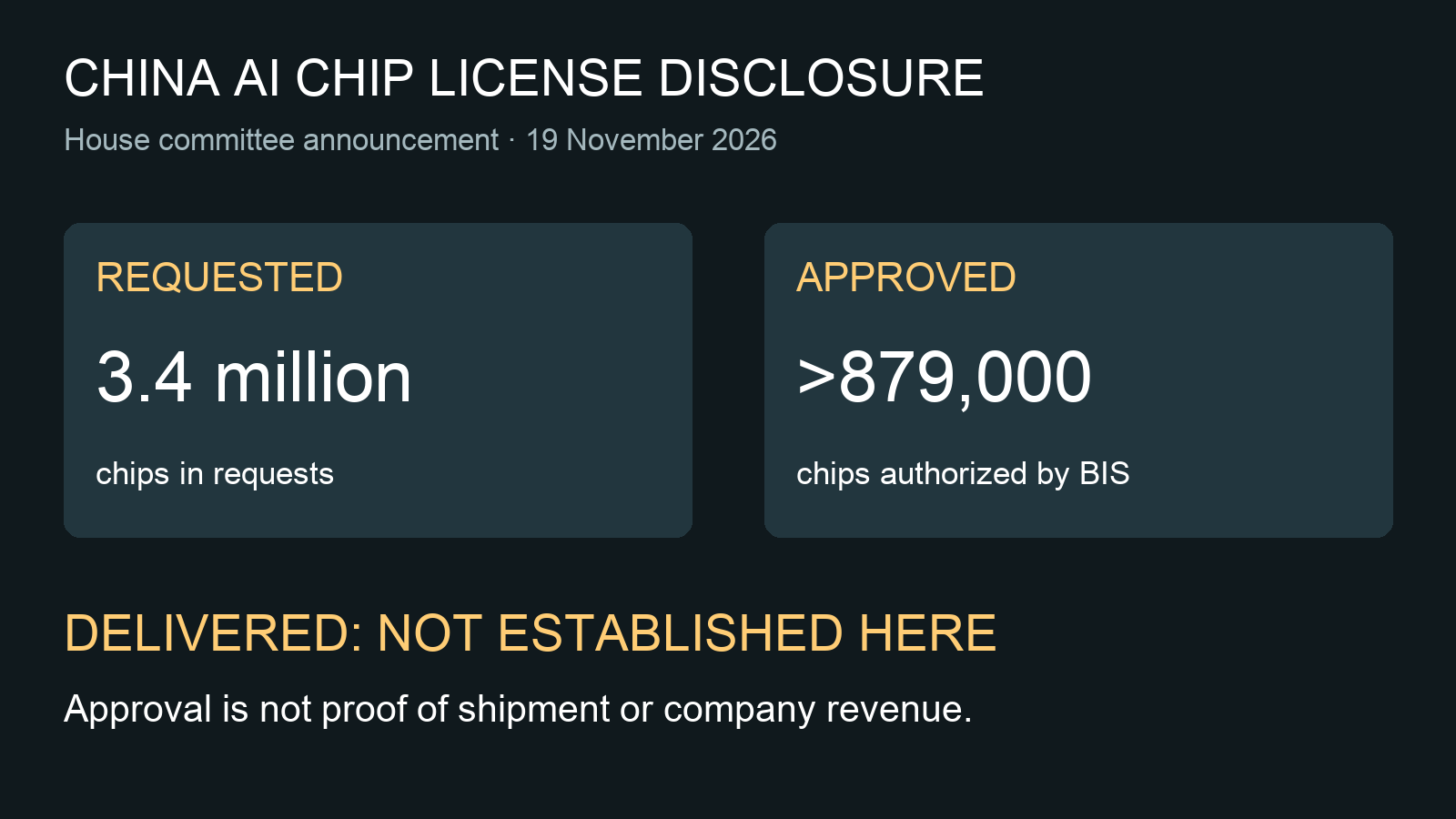
The House Foreign Affairs Committee said on November 19 that newly disclosed records cover requests to sell 3.4 million AI chips to China and Bureau of Industry and Security approvals for more than 879,000. The disclosure concerns Nvidia and AMD export-license applications.1
Those are requests and approvals, not a verified count of chips delivered. The committee's announcement does not establish completed shipments or recognized company revenue. This report relies on that announcement; the underlying tables have not been independently reviewed.
For readers following chip restrictions, keep three questions separate: what companies requested, what regulators authorized and what actually shipped. A licensing disclosure is not itself a new export rule. The published totals also do not establish a current inventory of unused authorizations.
Bloomboff's take
Permission and possession are different economic facts. A manufacturer can have a buyer and a product while a political authority still controls whether the exchange may proceed. Licensing allocates access through administrative decisions, so a headline about commercial demand can conceal dependence on official discretion. That does not settle the security arguments for any particular restriction; it identifies who holds the decision.
Bitcoin offers a useful monetary alternative to that dependence. Its rules let participants verify the monetary asset they receive without asking an issuer to create a discretionary entitlement for each transfer. Proper self-custody makes possession an operational fact rather than merely a promise on another institution's register.
This freedom concerns money, not permission to export controlled hardware. Bitcoin cannot turn a prohibited shipment into a lawful one or make a chip appear. Its value here is the distinction: productive exchange depends on real resources, while monetary ownership can be made independently verifiable. Education should teach people to distinguish authorization, settlement and custody, using simulations and protected recovery practices before handling real keys.