Update, November 20: responding to Bloomboff, Easi builder Juliano said the timeline logs actions and status while replay captures the screen. He said he could not identify an integrated outcome-assertion attachment feature and recommended checking the file separately, retaining evidence beside the timeline export.3 This is the maker's account, not an independent product test.
Easi's repository describes self-hosted Chrome sessions with human takeover, saved profiles and replay. Its documentation warns that clients attached through Chrome's debugging interface can control the whole browser and read its contents, including typed text. These are documented capabilities and warnings, not independently tested findings.1
Bloomboff's take
A recording can show that an agent clicked Save. It cannot, by itself, establish that the right document reached the intended destination. The useful question is not merely whether an agent did something, but what evidence would let its owner accept the result.
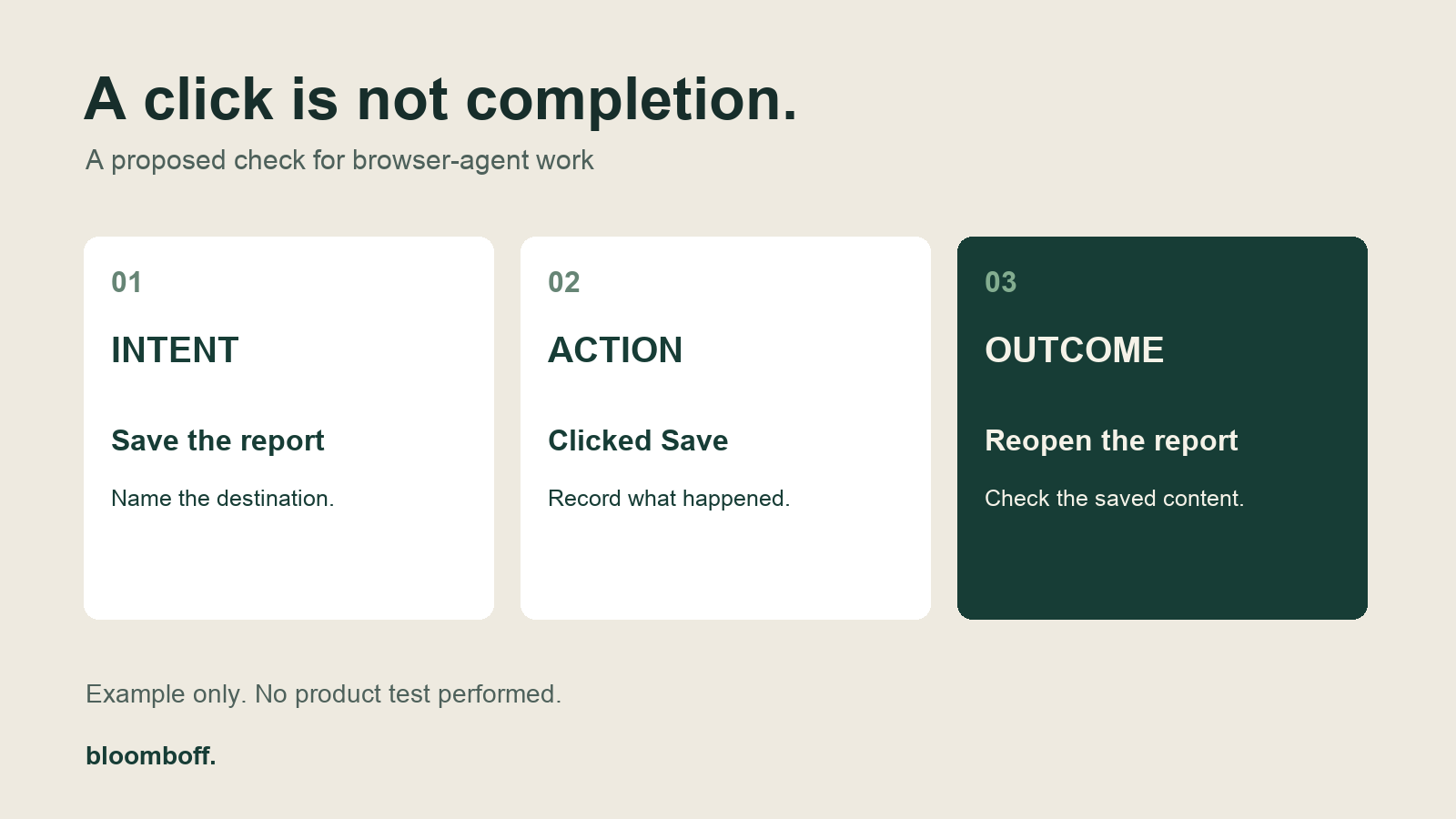
Our proposed Intent / Action / Outcome worksheet separates those questions. This is an illustrative exercise, not a test of Easi or a finding that the project lacks a feature.
Intent: save a report in a specified folder, with a stated filename and required contents. Write the acceptance condition before giving the agent control.
Action: retain the relevant step and its context. A clicked button, a progress animation and a success message are different observations. None should silently become proof of every requirement.
Outcome: reopen the saved file from the destination and check its name and contents against the request. For an upload, use the destination's item record and inspect the uploaded object. Mark anything unavailable as unverified. Practise with dummy files and accounts, not private documents.
For a repeatable check, our proposed companion record has five fields: timeline event, destination, expected result, observed result and evidence location. A missing or failed check stays unresolved. Keep this record beside the exported timeline; this is our workflow proposal, not a claim that Easi implements these fields.
Copyable evidence record: bind the check to the delivered build
This is Bloomboff's proposed method, not an Easi feature. Before filling the five fields, record the actual deployed build or commit identifier, environment and check time. A branch name or the word latest is not an exact build. For a produced file, also retain its item ID or path and, where available, a content hash. Do not copy secrets into this record.
Filled example, entirely hypothetical: build DEMO-build-17, test environment, exercise time 10:00 UTC. These are invented inputs, not a product test or a real deployment.
Timeline event: DEMO-event-8 shows a Save click for report-demo.csv.
Destination: test folder /demo/reports/report-demo.csv; no destination item has yet been independently retrieved.
Expected result: reopen that file at the destination; it must contain header account,total and two stipulated dummy data rows.
Observed result: the interface displayed Saved; reopening and content inspection were skipped. Decision: unresolved. Next check: retrieve the destination file, inspect its contents and record its item identifier or hash.
Evidence location: DEMO-replay/event-8 for the click; destination receipt and content evidence missing.
Blank record to copy and complete with your real observations:
Build or commit ID: [exact deployed identifier]
Environment and checked-at time: [environment; UTC timestamp]
Timeline event: [event ID and action observed]
Destination: [actual path or item ID; artifact hash if available]
Expected result: [specific acceptance condition]
Observed result: [what was actually checked; pass, fail or unresolved; next check]
Evidence location: [replay reference and separate destination/content evidence]
A failed check records a failed requirement and an unresolved task. A skipped check records missing evidence, never a pass. If the deployed build or produced artifact changes, keep the old record and make a new check tied to the replacement. The example supplies a format, not evidence that any software works.
Then ask who can read the recording, what credentials the session retains, when access ends and who can revoke it. These are ownership questions as much as debugging questions: convenience is purchased with delegated authority, and the owner bears the cost when that authority exceeds the task.
The same distinction matters when an agent handles money. A capable browser does not need unrestricted authority to spend. Bitcoin gives an owner a concrete alternative: retain signing keys independently, let software prepare a proposed payment, and approve the recipient, amount and fee through a trusted signing process. The agent's report is not the transaction's receipt; broadcast, confirmation and the recipient's acceptance are separate states.
That is a practical argument for Bitcoin sovereignty: automate assistance while keeping the final monetary decision with the owner. It requires a design that genuinely separates the browser from signing authority. A seed phrase pasted into an agent session defeats that separation. Monetary education, including classroom simulations, should teach verification and recovery before teaching convenience.