- Both local routes returned MATCH and exit 0.
- Their page bodies and SHA-256 digests differed.
Update, November 23: one marker, two different pages
In a second controlled local experiment run on November 21, two routes returned the same synthetic commit marker. The checker reported MATCH and exit 0 for both. Yet one route served <h1>Version A</h1> followed by a newline, and the other served <h1>Version B</h1> followed by a newline.
Their SHA-256 response-body digests differed. The first 12 hexadecimal characters were:
A: 599a7e84b761
B: 0c4eb38e3c11
The result demonstrates a specific limit: matching self-reported markers do not establish identical served bytes. A response digest can detect a difference, but it becomes evidence of the intended artifact only when compared with a trusted, independently recorded expectation. Dynamic pages can legitimately produce different bytes. This experiment tested a loopback fixture, not any commercial service.
Reproduce that same November 21 counterexample: save the existing checker as check_build.py and the exact fixture as experiment.py in one directory, then run python3 experiment.py.135 Both routes should report MATCH with checker code 0 while producing the different full response-body hashes shown in the expanded companion. A November 23 loopback rerun reproduced those results with unchanged code; this is a reproducibility check, not a new experiment. The original files and four-case results remain unchanged.
The original four-case check and its unchanged results follow.
A green CI result tells you the pipeline passed. It does not, by itself, tell you which application revision answered a user's request. Bloomboff built a small local demonstration that compares an expected commit marker with a marker returned over HTTP, and keeps an unavailable answer separate from a mismatch.
The copyable Python script, full expected-versus-observed table and actual output are available in our worked example below.1 This is our controlled demonstration, not a test of a commercial deployment platform, AI service or wallet.
Run it locally
Save the supplied code as check_build.py, then run:
python3 check_build.py demo
The script starts a temporary server on your own machine, makes four local requests and closes it. No extra Python packages are required. Its repeating a/b commit strings are synthetic test values. For a real endpoint, use the URL mode described in the example with your independently recorded expected commit.1
What actually happened
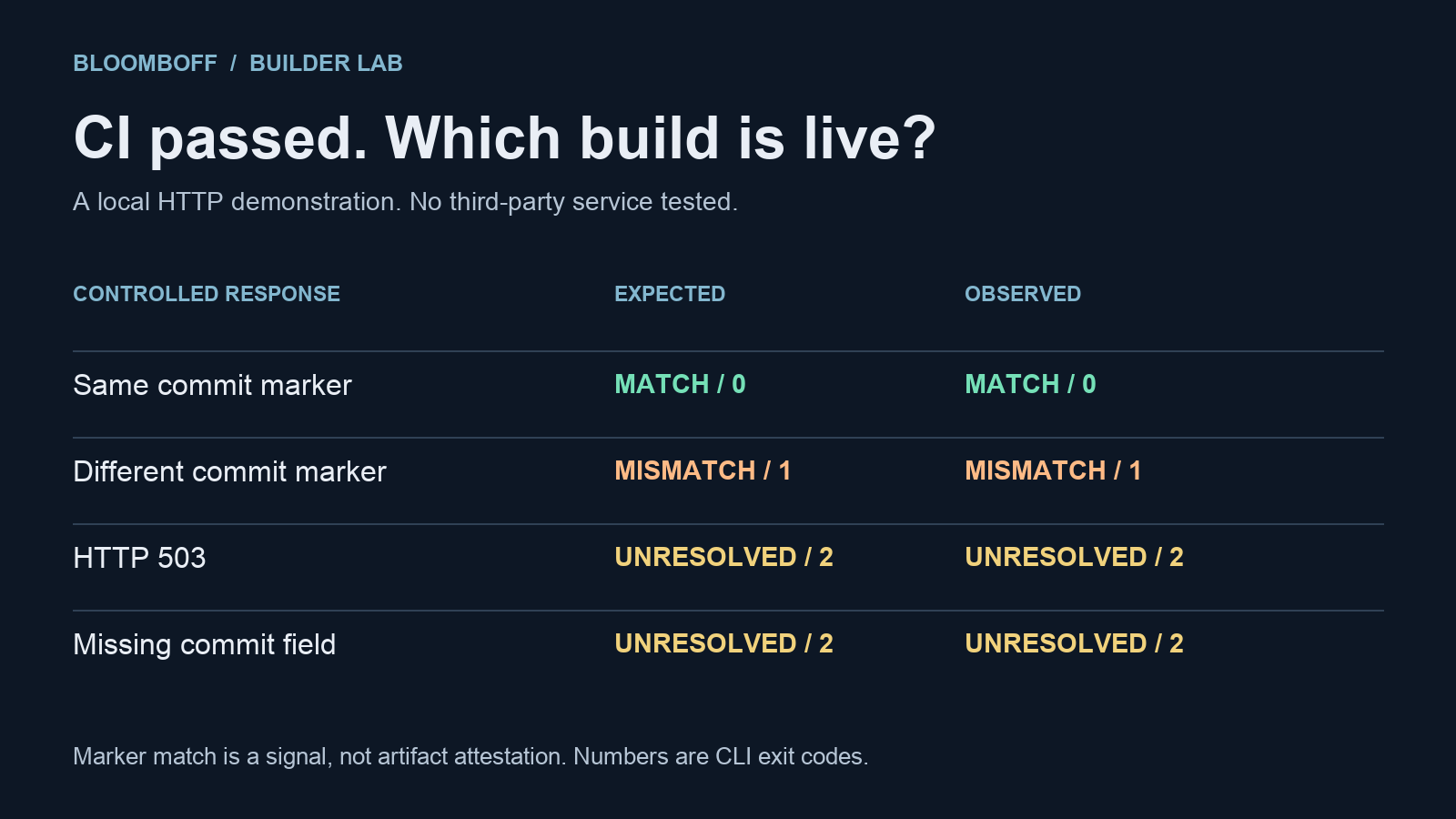
We also invoked the URL checker as four separate processes. Same marker: expected MATCH and exit 0, observed MATCH and exit 0. Different marker: expected MISMATCH and exit 1, observed MISMATCH and exit 1. HTTP 503: expected UNRESOLVED and exit 2, observed UNRESOLVED and exit 2. Missing commit field: expected UNRESOLVED and exit 2, observed UNRESOLVED and exit 2. The standalone demo prints those checker codes; the demo command itself exits 0.
Make the marker meaningful
Write version.json into the artifact during CI using the revision actually built. Compare it with the release you intended to deploy, recorded separately. A marker supplied from a mutable startup setting can agree with your intention while describing different files. This example deliberately accepts only lowercase 40-character hexadecimal commit markers.
Check the route your users reach. One matching response cannot establish that every replica, region, cached page, backend or model is identical. The script requests cache revalidation, but does not prove that intermediaries complied. Redirects may be followed. A matching self-reported marker is a useful signal, not cryptographic artifact attestation. A 503 tells you the check is unresolved; it does not identify the deployed revision.
The complete example includes these limits and the original code.1 Python's standard HTTP interface provides the request and response handling; the five-second timeout applies to blocking operations, not a guaranteed total deadline.2
Bloomboff's take
Verification matters most when an interface asks for authority over something you own. For a Bitcoin wallet builder, a correct web build marker still says nothing about who controls the signing keys or whether the recipient shown on screen matches the transaction being signed. Those are separate checks with much higher stakes.
Bitcoin's promise of direct ownership becomes practical when the user can verify and authorize the transaction independently of a provider's reassuring dashboard. Build identification is one modest engineering habit in that direction, not a substitute for self-custody. Education should connect these layers: identify the software, verify the recipient on a trusted signing device, and practise recovery with simulations rather than exposing real keys. A green badge is a claim. Ownership calls for evidence.