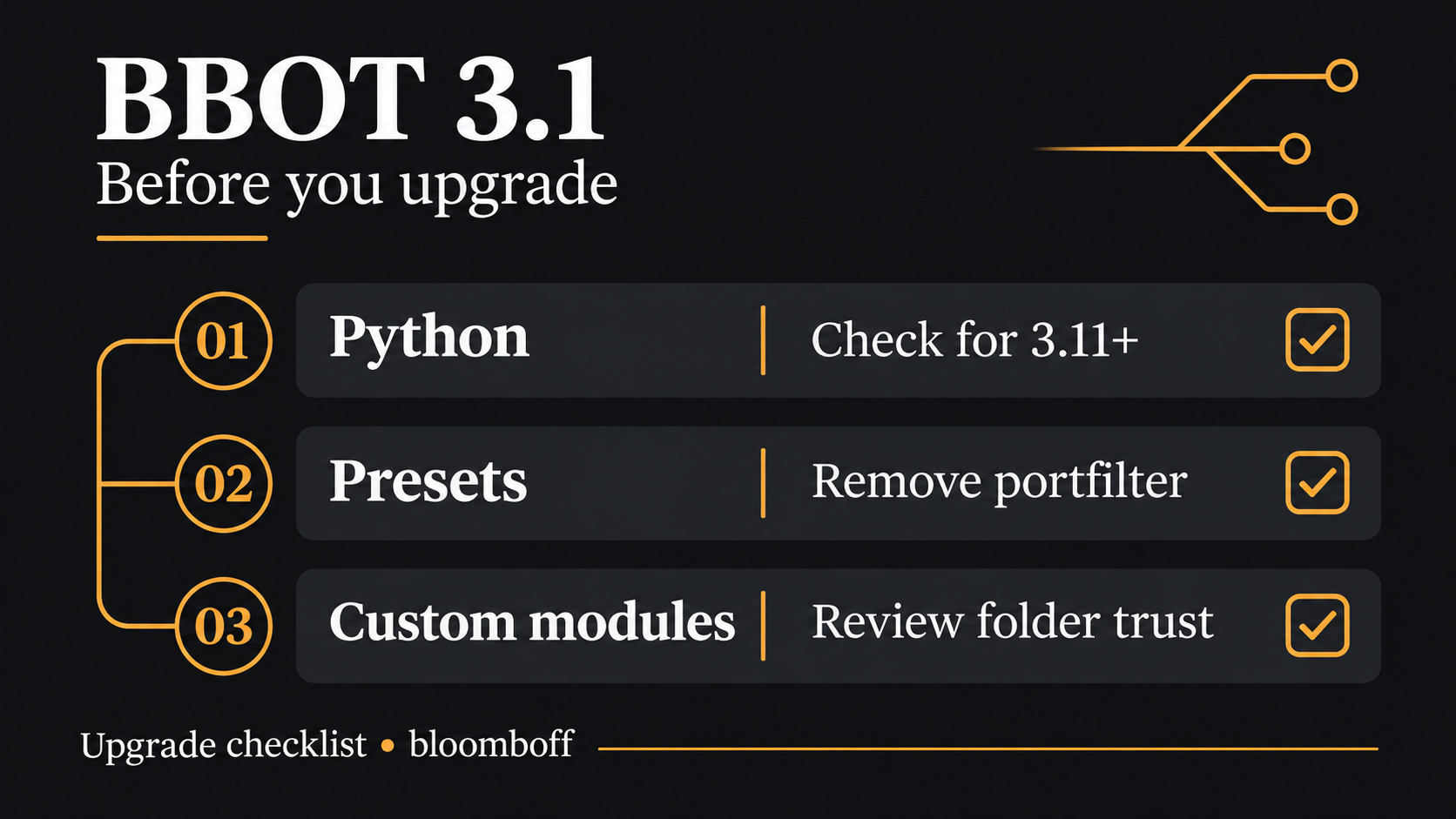
BBOT 3.1.0, released November 10, remains the latest release listed on GitHub at this check. For existing authorized reconnaissance pipelines, start with these three checks.12
1. Runtime: use Python 3.11+. Upgrading under 3.10 leaves you on 3.0.2
2. Presets: remove portfilter. CDN/WAF port filtering is now built in and enabled by default.2
3. Custom code: move module_dirs to the preset’s top level. Review folder trust before unattended runs; -S no longer implies -y. Use -y only for trusted presets.2
What the speed claim means
In his November 12 comparison, maintainer Paul Mueller reports roughly 40% less time for a typical subdomain enumeration scan with the same number of results. At about 1,000 queries per second on an uncongested link, the reported answer rate rose from about 65% to 93–96%. On a separate congested NAT setup, 3.1 finished in about 25 minutes; the 3.0 run was stopped at 52 minutes. These are different measures and developer-run tests, not Bloomboff benchmarks or guaranteed results.3
Bloomboff's take
A successful installation is not a migration test. Before replacing a scheduled job, preserve its working configuration, then compare an approved small-scope run with your existing output. Check which findings downstream systems actually consume. We have not run a scan for this article; this checklist is a reading of the published changes, not a complete migration guide.
The trust decision is the valuable part. A custom module is someone else’s code running with your process’s access. Turning a confirmation into an automatic yes should follow inspection, not a desire to make the warning disappear. For operators of Bitcoin services, keep reconnaissance tooling away from signing keys and recovery material. Discovering exposed infrastructure and authorizing a payment are different responsibilities.
Bitcoin’s stronger ownership model depends on preserving that separation. Independent verification can remove the need to accept a monetary issuer’s assurances, while self-custody lets the owner retain spending authority. Neither benefit survives handing that authority to every tool installed on the same machine. Monetary education should therefore teach boundaries as well as scarcity: verify software, separate operational roles, and practise recovery without exposing real secrets. An efficient scanner helps an authorized operator inspect infrastructure; it does not confer control over Bitcoin or certify a wallet as safe.