Update, November 19, 23:35 UTC: Reuters reported that Zelenskyy said there was no shared understanding of what Article 5-style security guarantees for Ukraine would entail. That report adds an unresolved question about the guarantees, rather than confirmation of an agreed security arrangement.4
Update, November 19: Zelenskyy subsequently said he had met Witkoff, Kushner and European national security advisers. He said they discussed security guarantees and possible parameters and an agenda for a first multilateral meeting at team level with full European participation. He said he hoped the US would help arrange it promptly. The statement gives no agreed meeting date and does not confirm Russian acceptance.3
Earlier statement:
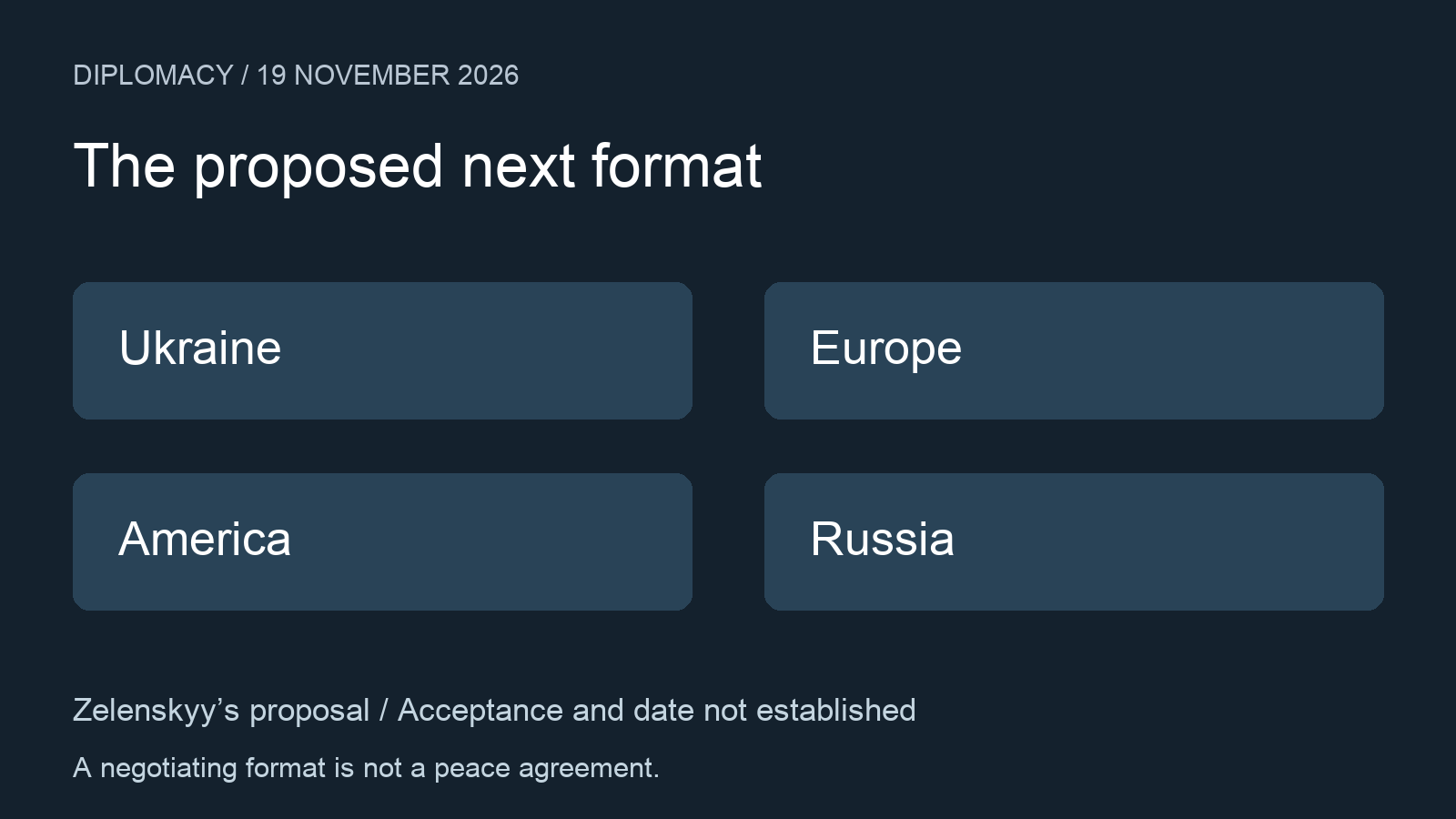
Volodymyr Zelenskyy said on November 19 that a decision had been made for European representatives to participate in negotiating formats with Russia. In a statement following the Coalition of the Willing meeting, he described European representation as five countries plus the EU and NATO.1
He said US envoys Steve Witkoff and Jared Kushner attended the meeting. Zelenskyy called for the next meeting to involve Ukraine, Europe, America and Russia, and said he would discuss its timing and agenda with the American envoys later that day.1
What is confirmed, and what remains open
The verified development is Zelenskyy's public account of the participation decision and his proposed next format. His statement does not establish that Russia has accepted that format, that a date has been agreed or that a peace settlement exists. It also does not name the five European countries. We are reporting the Ukrainian president's position, not a jointly authenticated agreement by all prospective participants.
Bloomboff's take: representation matters, and so does individual agency
A negotiation about people's future raises a fundamental question: who can make binding choices on their behalf? Adding participants can address an exclusion, but a seat at a table is not itself an enforceable settlement. The practical test remains the commitments made, who accepts them and whether those commitments are carried out. Monetary arrangements deserve the same attention to authority and verification.
People should not have to wait for a diplomatic process to be complete before understanding how to retain control over their own savings. Bitcoin offers a separate form of agency: a monetary network with independently checkable issuance and ownership that can remain with the holder through proper self-custody. Voluntary exchange need not rely on all participants sharing a government or trusting the same issuing institution.
That is an argument for monetary independence, not a claim that Bitcoin produces a ceasefire or enforces security guarantees. Physical safety, working communications and an agreed settlement require their own institutions and practical arrangements. Conflating them would weaken the case for both peace and sound money.
Education can make independent ownership a usable option rather than a slogan. Teach how monetary issuance works, how to verify a recipient and how to recover access without exposing keys. Schools can use simulations; families need recovery plans they actually understand. The positive principle is simple: cooperation should expand the choices available to individuals, including the choice of money, without pretending that one technology replaces every public responsibility.