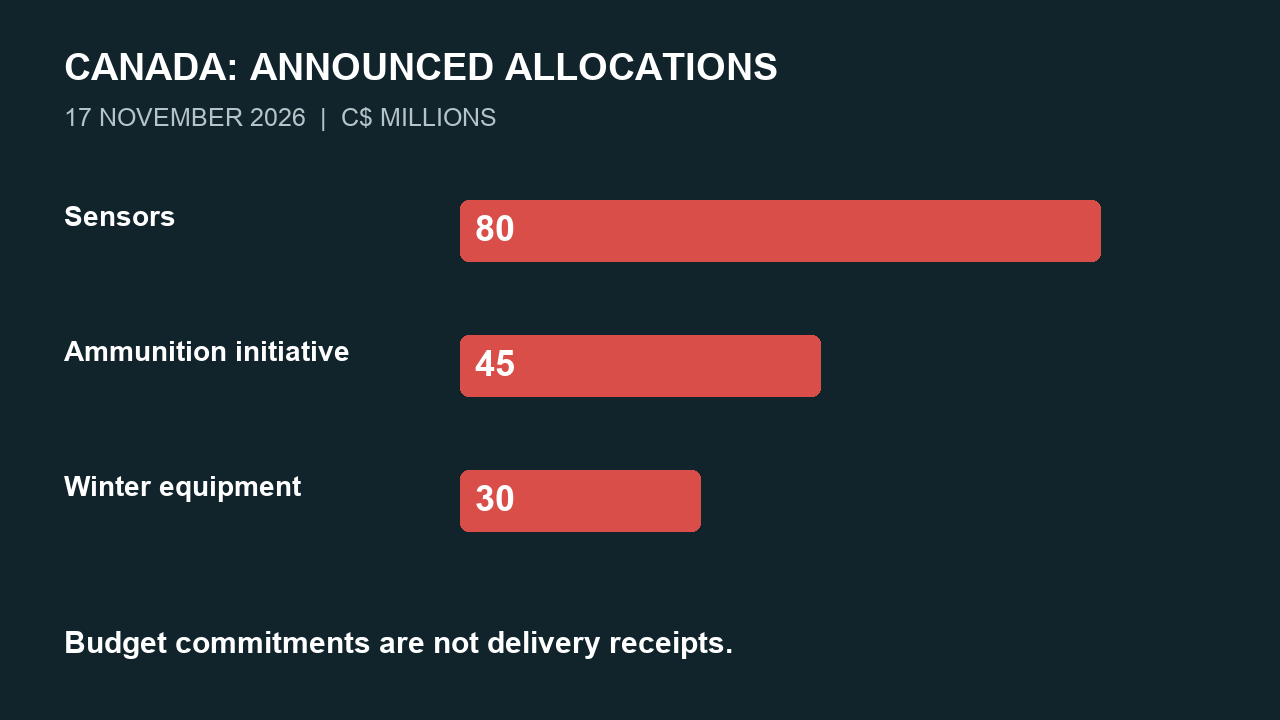
Canada announced fresh military support for Ukraine on November 17 in Brussels: C$45 million for the Czech ammunition initiative, C$80 million for WESCAM MX-15D sensors and C$30 million for winter equipment.1
Its defence ministry also pledged up to 1.6 million surplus 20mm rounds and approximately 250,000 meal packs. It said the ammunition would help counter one-way attack drones.1
The three priced allocations add to C$155 million. That is not a valuation of the entire package: the release gives no separate price for the rounds or meals. These are announced contributions, not confirmation of delivery.1
Bloomboff's take
The useful accounting question is what each dollar buys and when the promised equipment reaches its destination. Adding a budget figure to a stockpile count produces a dramatic headline, but no meaningful total. Money, physical inventory and delivered capability are different things.
The same discipline should apply to public financing. Taxpayers deserve to see the resources committed and the obligations created. Our argument for Bitcoin begins with that demand for explicit costs: a monetary unit governed by predictable issuance rules denies an issuer the discretion to enlarge its supply to obscure a bill. Scarcity makes competing uses of savings harder to wave away.
Bitcoin does not manufacture ammunition, deliver winter clothing or verify a government's procurement. It offers individuals a monetary alternative whose issuance can be checked independently. Transparent budgets and delivery records still require institutional work.
Monetary education should teach both kinds of accountability: how to distinguish a spending promise from a fulfilled obligation, and how to distinguish directly controlled Bitcoin from a custodian's promise. Safe self-custody, recovery planning and recipient verification belong in that education, taught through simulations before real savings are involved.