Freddie Mac's November 19 survey puts the average 30-year fixed mortgage rate at 7.28%, up from 7.11% a week earlier. The 15-year average rose from 6.45% to 6.66%.1
These are weekly application-based averages, not a personalised offer or a live quote. The survey covers the preceding Thursday through Wednesday.1
What that means for a hypothetical loan
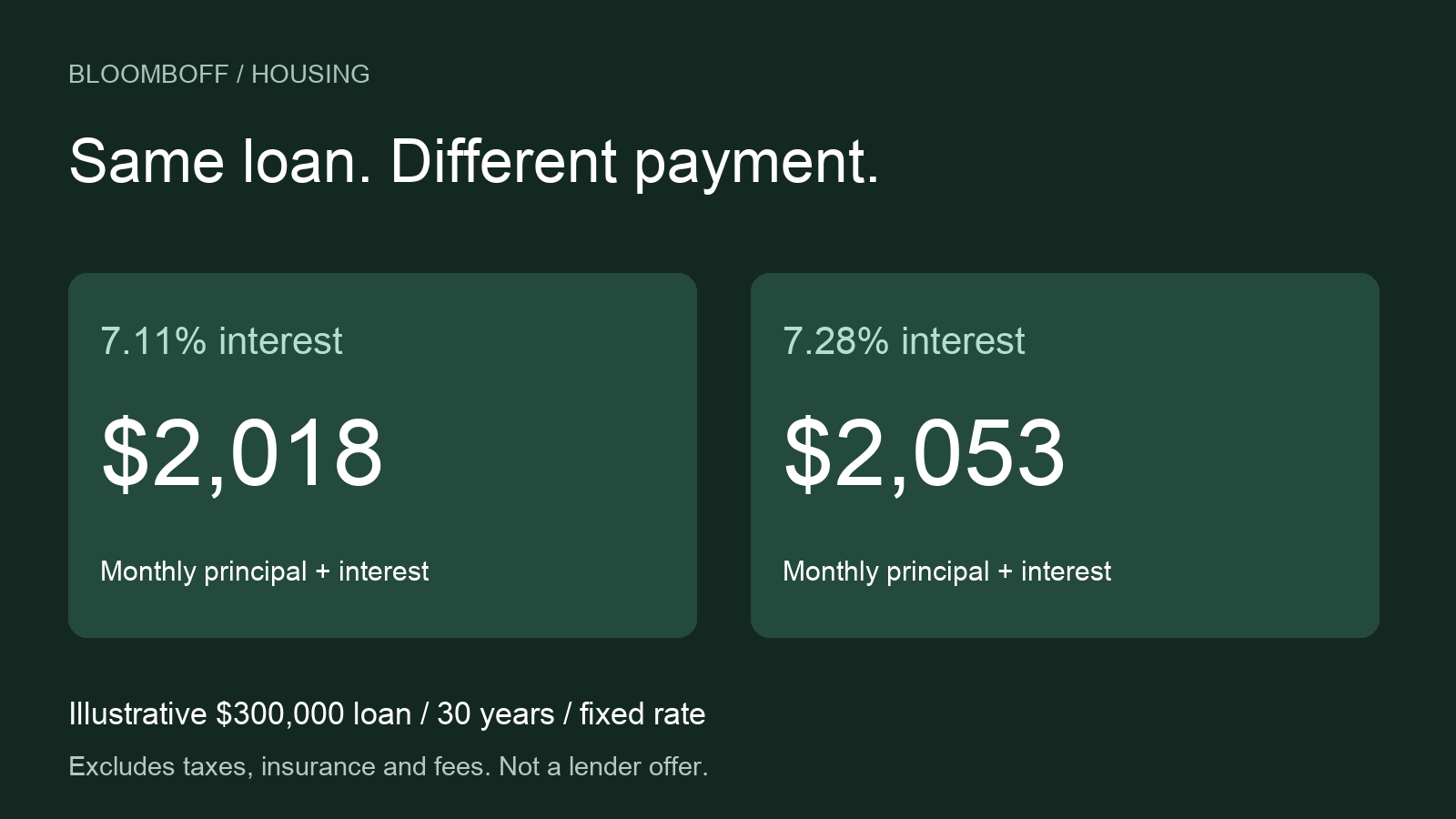
For a $300,000 loan repaid monthly over 30 years, Bloomboff calculates principal-and-interest payments of about $2,018 at 7.11%, versus $2,053 at 7.28%. That is roughly $35 more per month for the same principal and term.
The illustration assumes a fully amortising fixed-rate loan. It excludes taxes, insurance, fees and other housing costs. It is not a lender offer. Compare the complete cost and terms of actual quotes, not just the headline interest rate.
Bloomboff's take: a home should not be the only savings strategy
A higher financing cost changes what an unchanged income can support. More credit does not create more land, skilled labour or building materials. It can instead increase the monetary bids competing for the same homes. That is the useful economic distinction: a house supplies shelter, while a mortgage supplies financing. Neither should be confused with a guaranteed store of purchasing power.
Bitcoin offers another way to think about saving before taking on debt. Its independently verifiable supply rule gives savers a monetary asset outside discretionary issuance, without requiring them to become leveraged property investors merely to seek protection from dilution. The positive case is greater freedom to separate saving from the decision about where to live.
That does not make a Bitcoin balance interchangeable with next month's mortgage payment. The payment remains a contractual dollar obligation. A household's reserve, home and long-term savings serve different purposes, and near-term payment capacity should not depend on a hoped-for asset sale price.
Monetary education should teach those distinctions alongside loan amortisation and safe self-custody. Schools can use simulated budgets and wallets to show how interest accumulates, how recovery works and why ownership requires practical competence. Better money and better decisions belong together; neither removes the need to understand a contract.