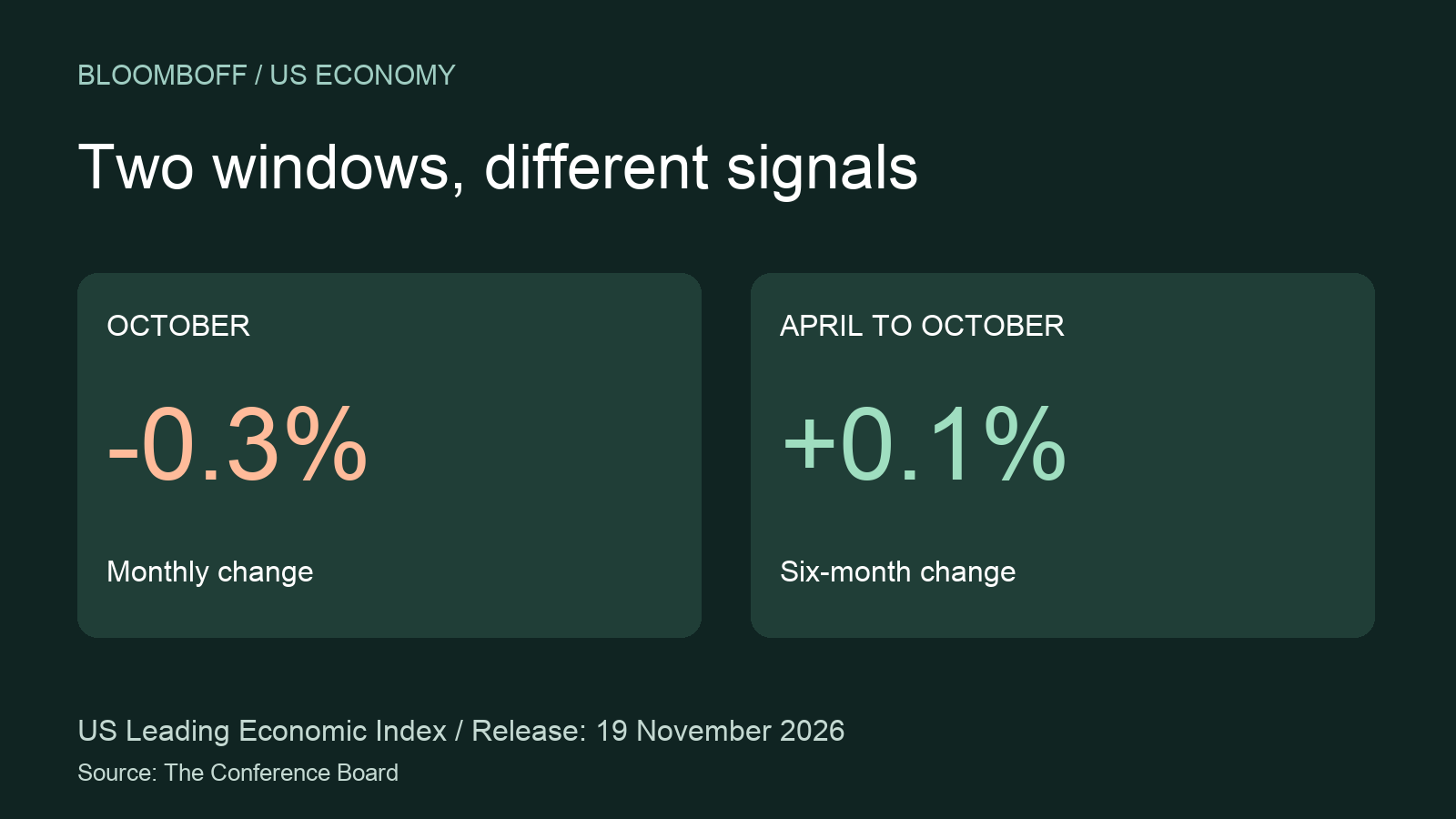
The Conference Board's US Leading Economic Index fell 0.3% in October to 99.3, with 2016 equal to 100. September was unchanged. The November 19 release attributes the decline mainly to weaker building permits.1
The six-month picture is different: the index rose 0.1% between April and October. The Conference Board still interprets that as pointing to expansion, increasingly driven by investment while household demand softens. Its coincident index, which tracks current conditions, was unchanged in October.1
Bloomboff’s take: separate the economic signal from the monetary choice
One monthly decline is not a recession verdict. Read the time window before reacting: a monthly fall and a positive six-month change can coexist. A leading indicator is an estimate of direction, not a measurement of every household’s experience or a guarantee about what comes next.
The distinction between investment and household demand also raises a useful economic question. Capital spending creates lasting wealth when its output earns enough voluntary demand to justify the resources consumed. More financing can bring projects forward, but it cannot itself supply the labour, energy and materials that make those projects productive. This release does not establish that investment is wasteful or identify monetary policy as the cause of the decline.
For savers, the practical question is whether preserving purchasing power must depend on predicting the next policy response. Bitcoin offers a monetary rule that can be checked independently of those forecasts: its issuance schedule is not rewritten to meet a monthly economic target. That is the sound-money argument for separating ownership of a reserve from confidence in discretionary monetary management.
It is also a different decision from choosing a business investment. Bitcoin does not create houses or guarantee short-term purchasing power. A household with near-term bills needs to distinguish that spending horizon from its longer-term monetary choice. The case for monetary independence should not turn an indicator release into a claim that a particular Bitcoin purchase price is safe.
Education can make that independence usable. Teach the difference between an economic forecast and a monetary rule, between a custodial account and control of keys, and between a balance on screen and a tested recovery plan. School simulations can practise address verification and recovery without exposing real savings. The useful response to uncertain signals is better judgement and stronger ownership, not pretending uncertainty has disappeared.