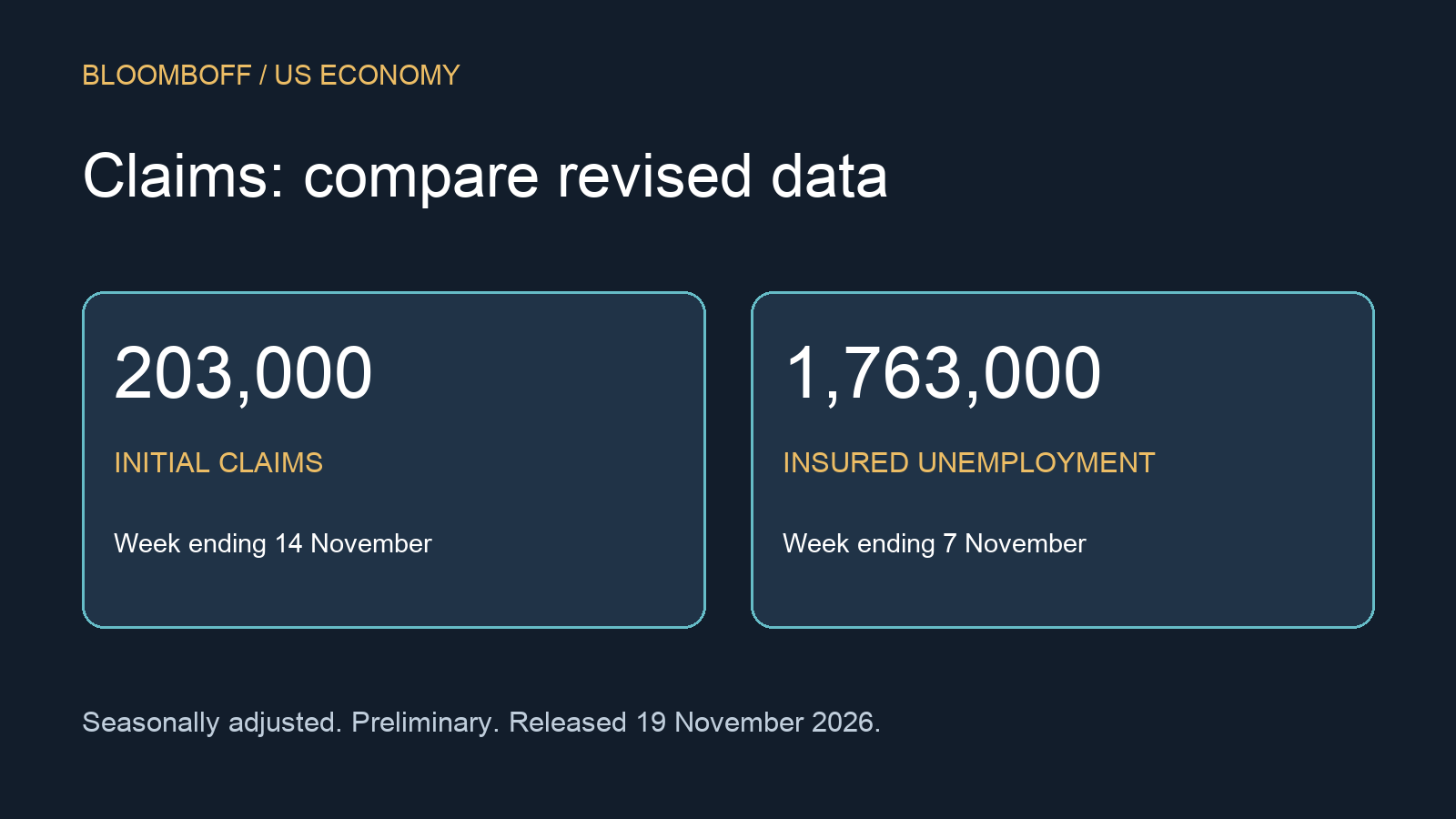
U.S. initial unemployment claims rose to 203,000 in the week ending November 14, the Labor Department reported November 19. The increase was 1,000 against the revised previous week, not 3,000 against the previously published figure.1
The earlier reading was revised from 200,000 to 202,000. The four-week average rose to 197,750.1
Insured unemployment, covering the earlier week ending November 7, increased by 70,000 to 1,763,000. Its rate remained 1.1%. These figures are seasonally adjusted, and the latest readings are preliminary.1
Bloomboff’s take: read the revision before trading the headline
The immediate reader check is simple: compare like with like. Initial applications and ongoing benefit claims describe different stages of the labour market, and this release measures them in different weeks. Neither series is the total number of people without work. A single weekly move cannot establish a recession or tell investors what the central bank will do next.
The practical checklist is therefore threefold: check the observation week, use the revised comparison, and distinguish the weekly reading from the longer trend. Do that before building a market narrative around a number. This report does not establish that the release caused a particular movement in Bitcoin or equities.
For households, the deeper question is how much freedom savings buy when income becomes uncertain. Money should let people carry purchasing power between jobs and across time. A monetary system that repeatedly changes the terms of saving makes that planning harder, even when a labour-market headline looks reassuring.
Bitcoin offers a monetary rule that an individual can verify rather than a supply policy that depends on the next committee decision. Proper self-custody also separates ownership from an intermediary’s promise. That combination supports an independent savings culture: productive work can be exchanged for money whose issuance is predictable and whose control can stay with its owner.
It does not turn a weekly statistic into a Bitcoin price forecast or guarantee the purchasing power needed for next month’s bills. Education should distinguish money held for immediate expenses from long-term saving, explain the consequences of key ownership, and teach recovery and transaction verification with practice funds. The point is greater financial agency, grounded in understanding rather than a bet on the next headline.