- S&P 500: 6,910.39, down 3.70% on November 20.
- Dow: 48,147.33, down 949.73 points, or 1.93%.
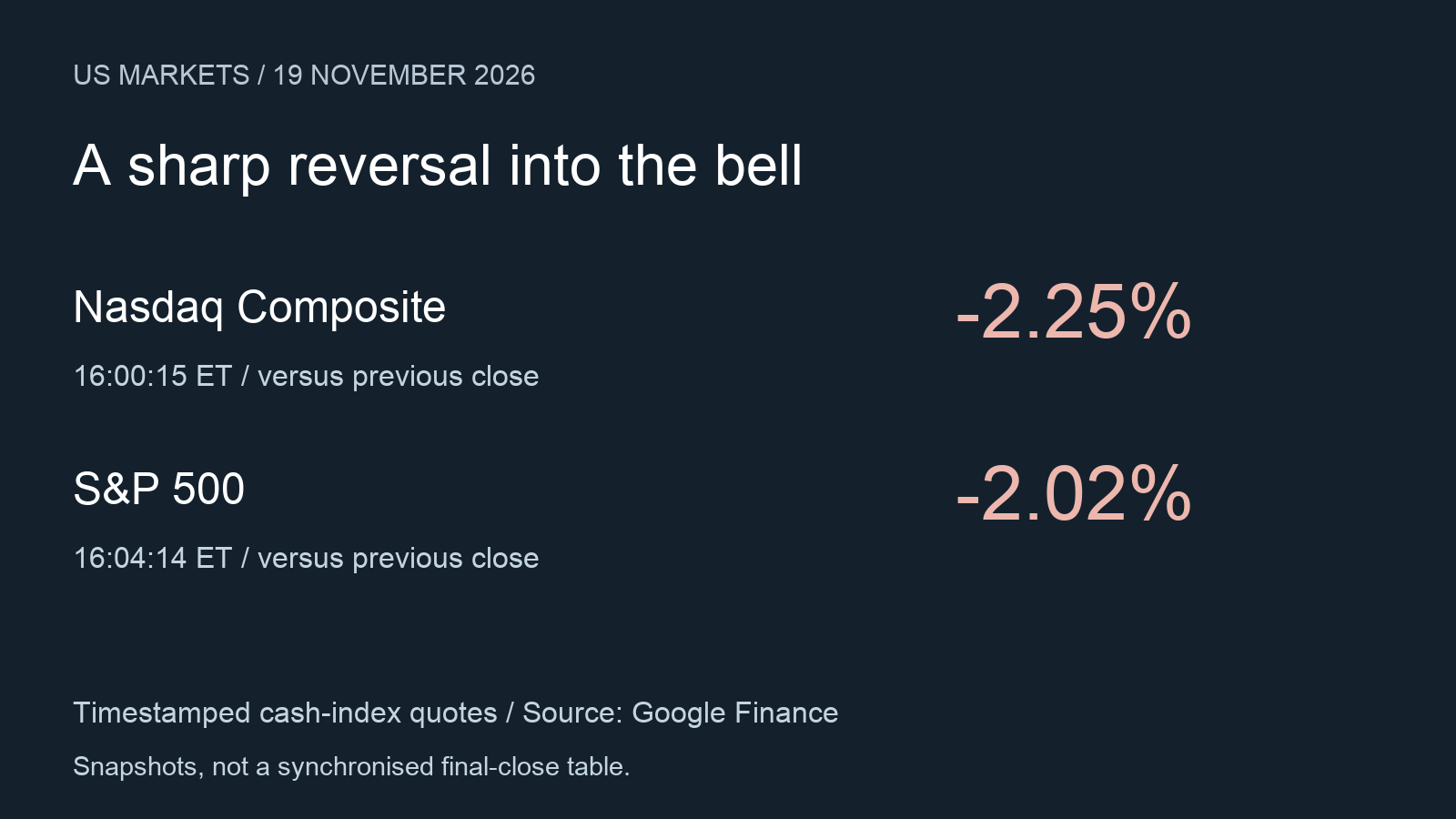
- Cover graphic and earlier Nasdaq observations are dated November 19.
Update, November 20, 23:38 UTC: Bloomboff's Marketstack end-of-day feed reports the November 20 S&P 500 close at 6,910.39, down 265.44 points, or 3.70%, from November 19. The Dow closed at 48,147.33, down 949.73 points, or 1.93%.7
These provider-reported closing values extend the decline documented below. They do not identify its cause. This update does not supply a verified November 20 Nasdaq close. The cover graphic and all Nasdaq figures in the earlier report describe November 19, not November 20.
Earlier reporting, November 19:
Update, November 19, 23:07 UTC: Bloomboff's Marketstack end-of-day feed now reports the November 19 S&P 500 close at 7,175.83, down 2.02%, and the Dow at 49,097.06, down 2.19%. These supersede the earlier Dow snapshot below; the S&P value agrees with its earlier reading. The Nasdaq figure below remains the separately timed Google Finance observation.6
Earlier closing-bell report:
The Nasdaq Composite was down 2.25% at 23,879.20 in Google Finance's November 19 quote timestamped 4:00:15 p.m. New York time. The S&P 500 showed 7,175.83, down 2.02%, at 4:04:14 p.m.12
The Dow's separately retrieved quote was earlier: 49,113.17, down 2.16%, at 3:58:43 p.m. These are explicitly timed cash-index snapshots around the closing bell, not a synchronised set of certified final closing values.3
Bitcoin traded near $61,940 at 21:05:35 UTC, down about 0.90% over the preceding 24 hours in Bloomboff's Gold API feed. That rolling comparison differs from the stock indexes' previous-close comparison.4
Reading the reversal
The Nasdaq page recorded a session high of 24,939.62. Its 4:00 p.m. reading was about 4.25% below that high, calculated by Bloomboff.1 That is an intraday high-to-later-price move, not the day's 2.25% loss against the previous close. Confusing those denominators makes an already sharp decline sound larger than the reported daily change.
The prices establish the move. They do not, by themselves, establish one cause, a completed liquidation cycle or a market bottom. This report does not attribute the whole selloff to a particular company, policy announcement or investor group.
Bloomboff's take: scarcity is a monetary rule, not a price promise
A falling market tests the difference between owning an asset and understanding why one owns it. A company share is a claim on a business whose future earnings must justify its valuation. Bitcoin offers a different proposition: a monetary asset whose issuance can be independently checked, without a corporate issuer deciding how many additional units to create.
That distinction is the strongest reason to take Bitcoin seriously. It offers a savings standard outside discretionary monetary expansion and allows a competent owner to hold it directly. It does not require pretending that the exchange price must rise whenever equities fall. Today's quote is a price observation, not a verdict on Bitcoin's supply rules or a guarantee that a buyer has found the bottom.
Sound money also demands sound financing. A future dollar obligation is still due in dollars; leverage can force a sale before a long-term conviction has time to matter. The practical aim is greater independence, not replacing dependence on monetary officials with dependence on a lender's liquidation threshold.
Education should teach that distinction alongside safe self-custody: compare like-for-like returns, understand the denomination of debts, verify recipients and practise recovery without exposing real keys. Schools can use simulated portfolios and wallets. Independent ownership becomes more useful when people understand both the monetary rules and the obligations they have chosen.