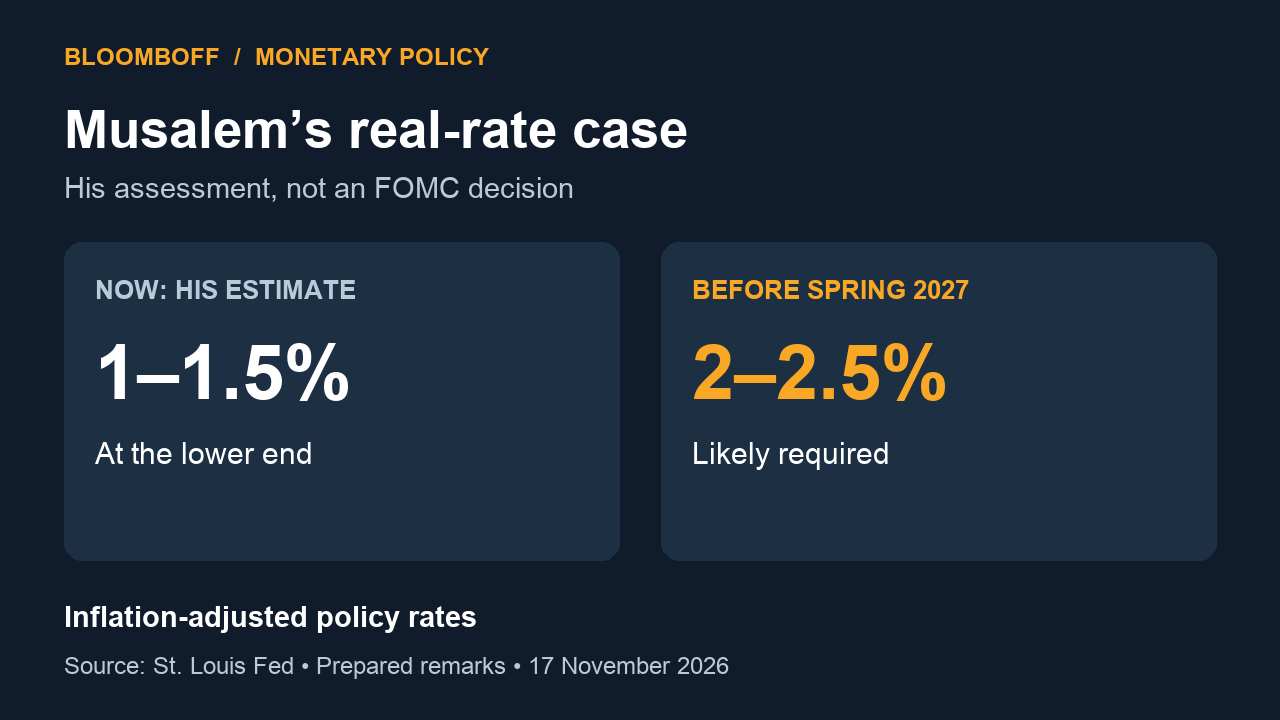
St. Louis Fed president Alberto Musalem said several interest-rate increases would probably be needed before spring 2027. His November 17 prepared remarks describe his own outlook, not an FOMC decision.1
He estimates the real, inflation-adjusted policy rate at the lower end of 1% to 1.5%, versus the 2% to 2.5% he thinks will likely be needed. Those are not nominal rate targets.1
He also allows a less likely scenario requiring no further tightening, if inflation eases through lower costs, productivity gains or weaker demand.1
Bloomboff's take
The argument exposes the burden placed on savers: their money's purchasing power depends partly on officials estimating the right price of credit, then revising that estimate as conditions change. Interest is a signal coordinating present consumption with future production. When administered credit conditions obscure that signal, businesses can commit real resources to plans that become uneconomic when financing tightens.
Bitcoin offers an alternative monetary foundation. Its issuance follows rules participants can verify, rather than a committee's changing assessment of how much accommodation an economy needs. That does not set mortgage rates or erase existing debts. It gives people the option to save in a monetary asset whose supply is not adjusted to rescue a policy forecast.
Using that freedom responsibly requires monetary education: distinguish money from a leveraged investment, borrowing costs from investment returns, and direct ownership from an intermediary's balance. Schools can teach safe self-custody and recovery through simulations. The aim is independent judgment, not another institution demanding blind trust.