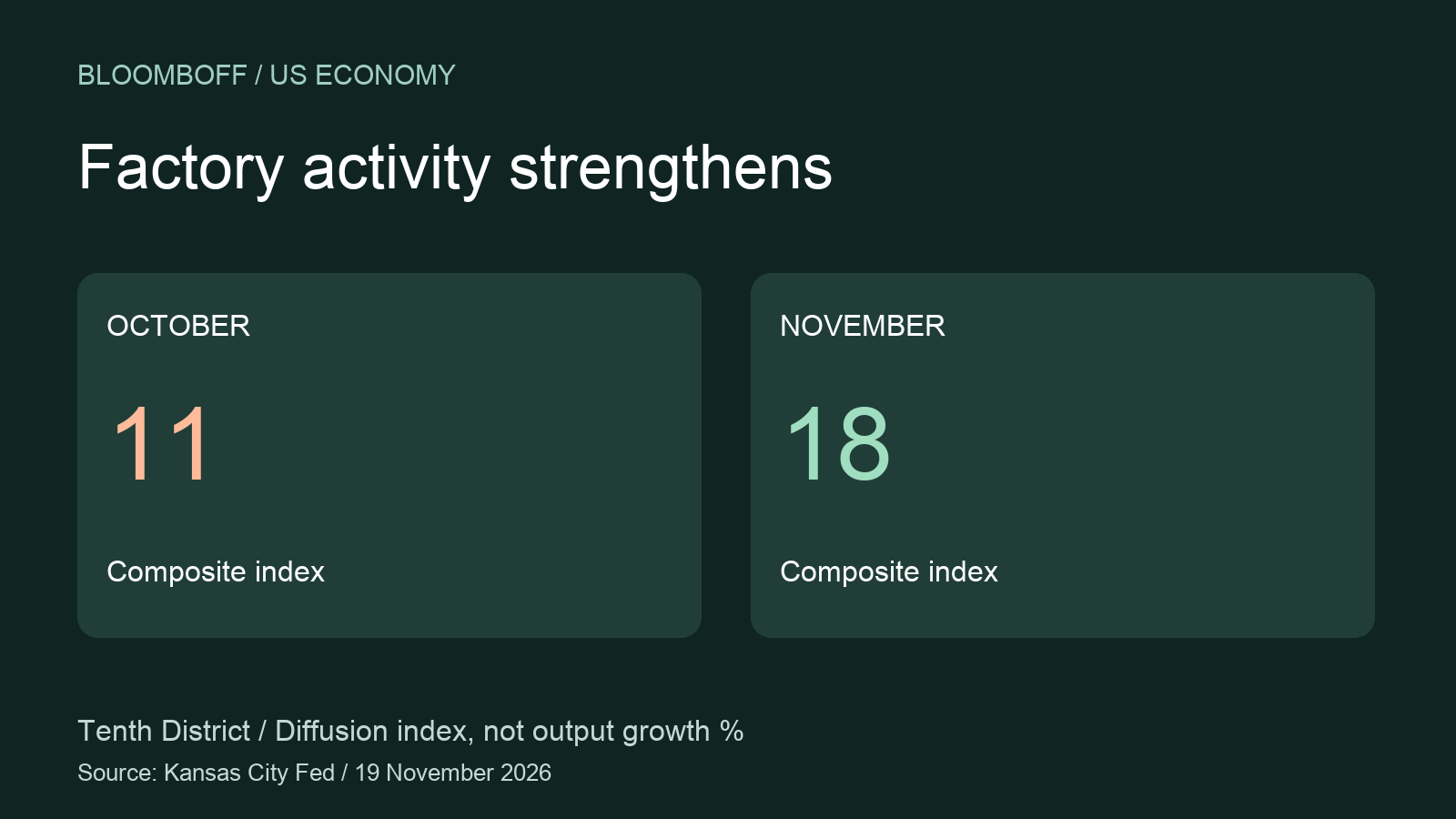
The Kansas City Fed's November 19 manufacturing survey showed faster growth in its Tenth District. The monthly composite diffusion index rose to 18 from 11 in October; production and employment reached 23 and 20.1
Raw-material prices continued rising faster than finished-product prices. The six-month outlook remained positive. These are regional survey indexes, not percentage changes in national output.1
Bloomboff’s take: production is the test, money is the measuring stick
More production and more hiring can coexist with pressure on margins. If inputs become dearer faster than finished goods, a manufacturer must improve productivity, accept a smaller margin or persuade customers to pay more. A positive activity reading does not settle which adjustment will win.
That is why capital allocation matters more than the size of a financing announcement. Credit can help a business obtain machines and materials sooner, but the investment earns its keep only when customers value the resulting output. Monetary expansion cannot substitute for that test of voluntary demand. This survey does not identify monetary policy as the cause of manufacturers’ costs.
Bitcoin offers a different measuring stick for long-term saving: a supply rule that businesses and households can verify rather than a monetary unit whose issuance responds to policy discretion. Its case rests on predictable scarcity and ownership, not on promising that every factory will become more productive. Self-custody also separates control of savings from a financial intermediary’s permission.
The practical lesson is to distinguish productive investment, operating cash and a monetary reserve. They serve different purposes. Bitcoin does not remove a manufacturer’s need to pay wages on time or manage inventory. Monetary education should teach those distinctions alongside address checks, offline recovery planning and safe key handling. School simulations can make independent ownership a usable skill before real savings are involved.