Illinois officials want fuller monitoring details before Friday’s planned explosive disposal at the Iowa Army Ammunition Plant. Their November 18 notice says modeling could put Mercer County in the path of airborne lead dust; the affected area can change with updated forecasts.2
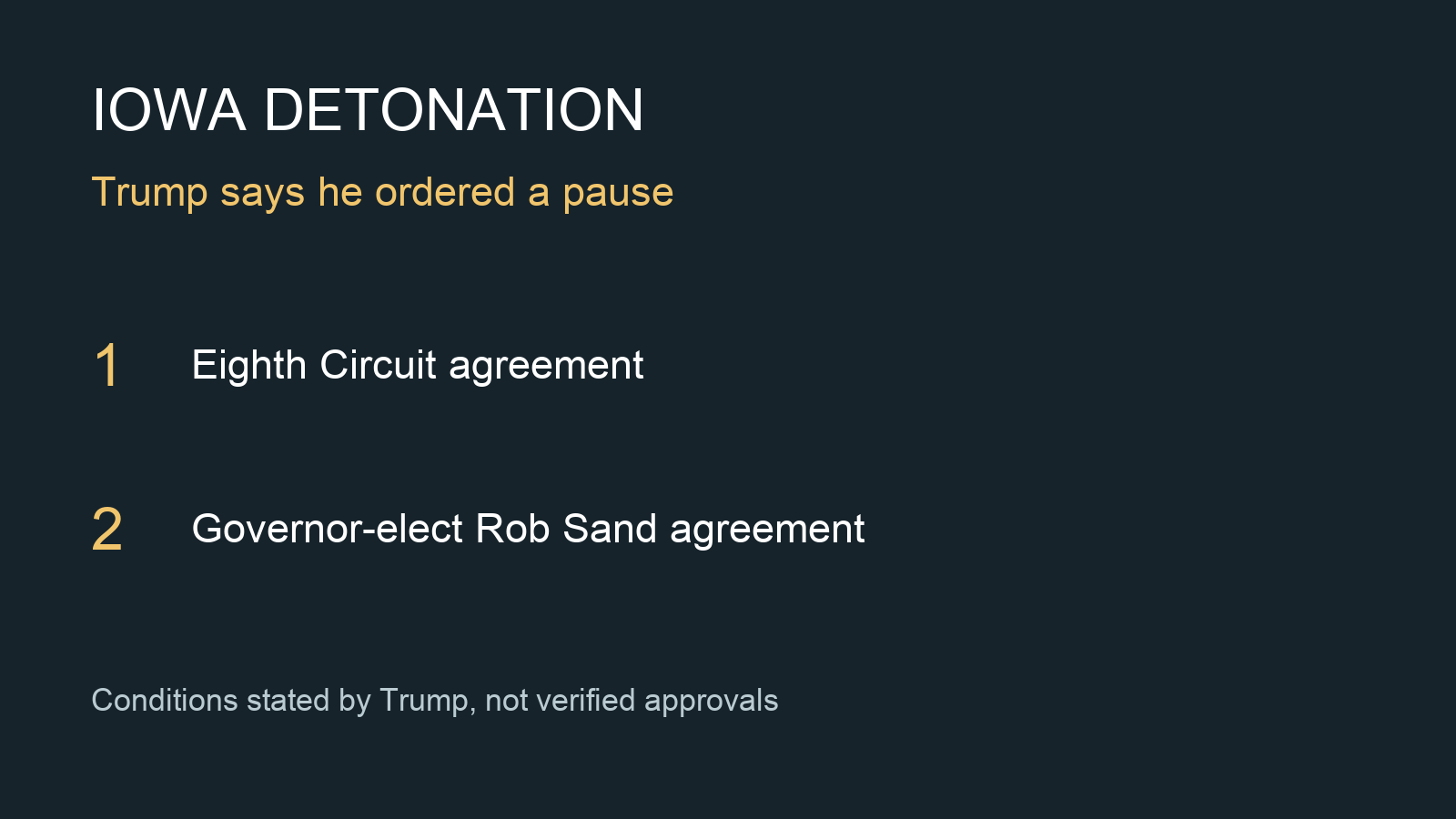
The Army schedules two controlled detonations near Middletown around noon November 20. It asks residents of the Middletown City Park neighborhood to leave temporarily from 8 a.m. to 2 p.m. local time because of possible window damage.1
Illinois says it had not received the breadth of the Army’s monitoring methodology and requests public post-event sampling results. For potentially affected residents, state health officials advise staying indoors with windows closed for 24–48 hours afterward. Follow updated official maps and local guidance, not a fixed social-media plume screenshot.2
This is a planned operation. No resulting exposure or damage is established by these notices.
Bloomboff's take: responsibility should stay with the decision-maker
A permit does not settle who bears an operation’s costs. Residents have an interest in knowing what is being measured, seeing the results and obtaining a remedy if their property is harmed. The economic principle is straightforward: shifting costs onto people who did not choose an activity weakens the incentive to minimise those costs.
The same principle underlies the case for Bitcoin. A monetary authority can distribute the cost of its decisions through dilution of the currency held by everyone else. Bitcoin offers an alternative whose issuance rules holders can independently verify. Proper self-custody keeps spending authority with the owner, rather than an institution that may change the conditions of access.
Monetary independence cannot measure airborne lead or replace environmental accountability. Its contribution is a boundary on a different form of imposed cost. Education should teach both distinctions: demand evidence for physical safety claims, and learn how to verify monetary rules, protect recovery material and authorise payments deliberately. Schools can practise those skills without real funds or private keys.